
Zero Click Marketing – Targeting Featured Snippets in Google Search

Targeting featured snippets is a great way to build brand awareness and drive traffic to your website, without you necessarily needing to improve your organic Google ranking, as would otherwise be the case.
These pop-out boxes appear in some Google search results, providing a quick and concise answer to the user based on content pulled from a webpage.
By ensuring that that content is information you’ve created, you can build trustworthiness in the eyes of Google’s almighty algorithm and bring leads to your website. According to data, featured snippets can account for almost 8% of all clicks.
You can bet your bottom dollar that those 8% of clicks represent a serious business opportunity, if you can crack what’s known as “Zero Click Marketing”; so called, because theoretically the user doesn’t have to leave the search engine to interact with your brand.
Fortunately for you, we’re here to help you do just that! Discover exactly how to optimise for featured snippets, and just why these innocuous little informational boxes are so important, below.
Hold up…what is a featured snippet?
We’re so glad you asked. Featured snippets provide quick, short answers to a user’s search query. They appear at the top of a Google search result, providing the answer to a question without the user having to click through to another site.
You’ll probably have seen them appear in some of your Google searches. They can include:
- Snippets of paragraphs
- Images
- Bullet point lists
- Numbered lists
- Punchy sentences
Featured snippets are also known as “answer boxes”. They work by pulling through a section from a third-party webpage that Google believes best answers the user’s question. So, for example, if you were to search for “How do I change a car tire?”, you’ll most likely be served a featured snippet from an article that answers this question in the simplest and most concise manner.
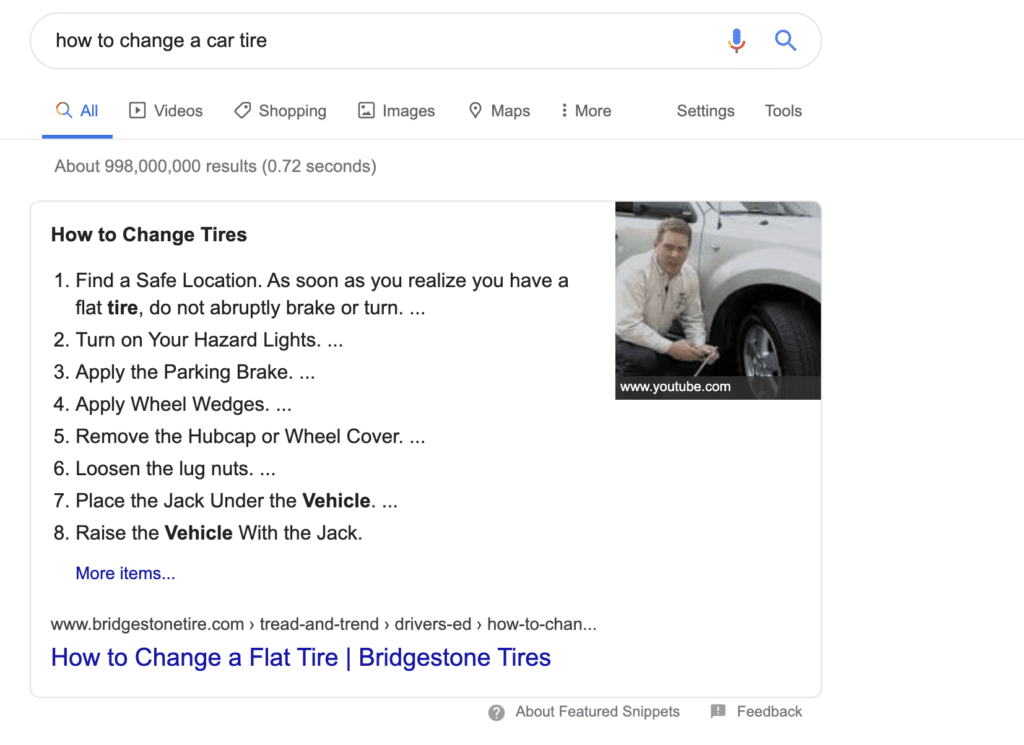
They really captured this chap’s best side.
Why are featured snippets important?
Featured snippets appear at the top of a Google results page, meaning that if you can optimise your content enough to be included in one, your webpage URL, link and content will appear at the top of the page for a search term.
Appearing first in Google search means that your webpage will be the first that a user will come across when looking for an answer to their query. Scoring a featured snippet also means Google’s algorithms have identified your site as a trustworthy source of information, which can help when ranking for other terms and keywords.
Not only can appearing first increase brand exposure and click-through rate, getting more visitors to your site could deliver better leads, more engagement and a higher conversion rate. All pretty sweet, considering you don’t necessarily have to be the most well-optimised site as a whole to land the featured snippet spot (more on that later).
How to optimise for featured snippets
There are several ways your blog content can be optimised to better target Google’s featured snippets.
That said, optimising your content is never a guarantee to success (few things are, with these mysterious search engine algorithms).
Google’s decision on which page to include as a featured snippet depends on a wide variety of factors, from site authority to the number of trusted backlinks pointing to it. Still, by ensuring your content is as optimised as possible, you’ll be placing yourself in the best position for success.
You can optimise for featured snippets by:
- Producing content that answers a particular search question – many users will search Google for the answer to a particular question, such as ‘What is a featured snippet?’. Try to produce content that answers this in a simple and concise manner.
- Mark up your H2s with the search query keyword – make sure your H2 (Heading 2, in your site’s HTML markup) titles are the search question itself, such as ‘How to boil an egg’. Your content should then provide the answer within the first few sentences. You can always elaborate in the next paragraph.
- Find inspiration in the “People also ask” box – if you’re struggling for question style content, check out what questions people are searching for around your targeted keyword or business. Bonus tip: try to use the question site Quora for inspiration – questions found on here are unlikely to already have a compelling answer in Google (hence why they’re being asked elsewhere!).
- Use natural language – making your content easy and simple to read and understand improves your chances of being pulled into an answer box.
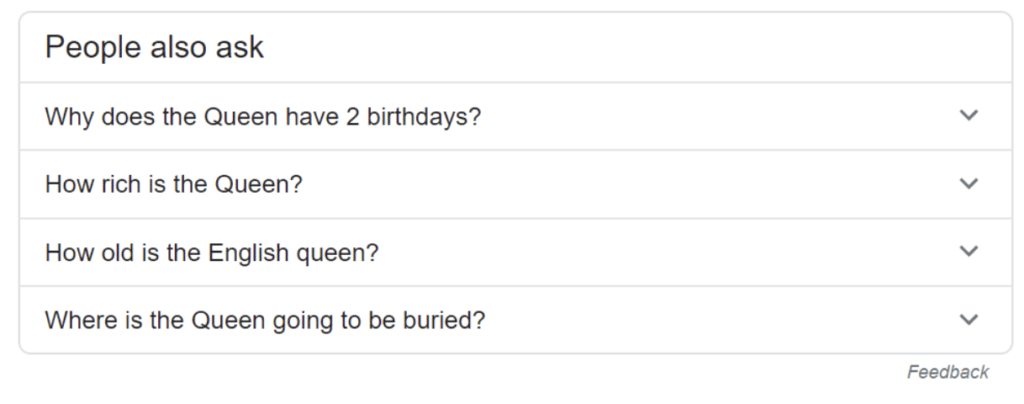
People Also Ask: from innocent to ever so slightly morbid in 4 questions.
- Ensure your site is well optimised – Google prioritises a well-designed and functioning site as the source for its featured snippet. Tip: check out our 9 top tips to on-page SEO for a good starting point for getting your whole site nicely optimised.
- Prioritise UX formatting – the way your content is laid out can affect your chances of appearing in a featured snippet box. Use appropriate header tags, break up paragraphs after a few sentences and ensure bulleted or numbered lists are used where appropriate.
- Keep your answers brief – featured snippets tend to be short and concise, typically coming in at under 100 words total.
- Do some competitor research – if you’re targeting a particular search question or keyword and a featured snippet is already appearing in Google’s search results, have a look over this new competitor and see if you can work out what they’re doing right and decide how you can better it.
What’s the click-through rate for featured snippets?

Featured snippets can account for around 10% of traffic around a particular keyword or search term. Though it’s no secret that the website in the first position often gets the most clicks overall, having your webpage appear in an answer box will have you appearing ahead of even that site in a SERP ranking, leading to better brand awareness.
Do featured snippets include voice search?
Google pulls most of its answers to voice search activity from its featured snippet information. So, every time you ask your voice-enabled device or smart speaker “Who wrote Harry Potter?” or “How many people live in the USA?”, the answer Alexa or Siri reach for will be pulled from an answer box.
Voice search answers don’t differ from traditional typed search engine query results either. These types of searches are becoming ever more prevalent, as sales of voice-enabled smart devices rise, making proper targeting for key phrases and terms more important than ever.
Wrapping it up
Featured snippets can be a great way to draw visitors to your site and increase brand awareness for your company or webpage, and we’re hoping this article will have given you an idea or two about how you might get started on this whole “zero click” bandwagon.
If you want to find out more about harnessing featured snippets and optimising your site for better search engine results more generally, speak to us.
GOT BIG IDEAS?
Need to step up your search marketing this year, with a water-tight plan to shoot up the rankings? Or perhaps your website isn’t converting as you’d like it to and you’re not sure how to pump up those online enquiry numbers. Gotcha – we’re here to help.
Please use the form below to let us know of your grand designs and we’ll be back in touch to (hopefully) help make them happen.

