
The Ultimate Guide to Optimising Your Recruitment Website for Search Engines

So, you’ve got a shiny new recruitment website – it looks nice and professional, the UX (user experience) is great, and you’ve clearly signposted where your candidates and clients should go to get in touch with you (if a client) or upload their details to join your network (if a candidate). Great! There’s only one problem – how are those candidates and clients going to find you in the first instance?
By searching for your services on Google, of course! In the case of candidates, they might search for jobs in your sector or one of the subsectors that you cover. As for clients, they might be looking for specialist executive search firms in your niche.
It’s clear that ranking well in search engines is important for your website to get the attention it needs, for your business the leads and quality connections it deserves.
That’s where SEO comes in, and in this article we’re going to examine how recruitment agencies can properly optimise for search performance in order to achieve ranking success.
1. TARGETED PAGE STRUCTURE
While SEO can be a tricky and deep subject, most of your returns will actually come from applying the fundamentals very well. It doesn’t get much more fundamental in the realm of SEO than solid page structure, targeted logically for keywords your audience might actually search.
What do we mean by page structure and targeting? Simply, that all of the titles, sub-titles, and the metadata (that’s the stuff that search engines use to read your page) all contain the keyword or phrase you reckon your users might search to find you.
For example, let’s say you’re a recruiter working within Life Sciences, and you’ve got a specific focus on Medical Devices. You need to be ranking when someone searches ‘medical devices recruitment‘, which might lead you to consider building and optimising your page specifically for that key phrase.
That’s exactly what (#1 ranked on Google for that phrase) Zenopa Recruitment have done with their landing page (a fancy marketing term for a page users will be ‘landing’ on from the search results) – their URL contains ‘medical devices recruitment’ (zenopa.com/medical-devices), it’s in the page title, and even features in the blurb:

That’s a recipe for ranking success. Put yourself in your audience’s shoes. What are they going to search for? It’s likely that they’ll always be searching for something fairly niche. Someone looking for a job in the Roofing and Cladding sector, for example, isn’t going to generically search for ‘building products jobs’ – he’ll search exactly for what he’s looking for – a Sales Director for his cladding business, for example. You have to pre-empt what your audience might search for, and build pages to target those terms.
The nicher you go, the better. Think how valuable just one good client in a sector is. The great thing about this method is that because the key terms you’re targeting are so niche, there’s not likely to be much competition and it shouldn’t take too long to get yourself in the high-converting top 3 spaces on the SERPs (Search Engine Results Pages).
The final thing to note is that unless you instruct Google otherwise, every page of your site will be indexed by search engines, so that makes things like Blogs very useful to broaden your range of keywords and help potential new clients and candidates find your site.
We do a lot of work for recruiters at Saint Digital, so I don’t mind admitting that even writing this blog post now, I’m hoping that through searching, recruitment business owners might stumble across our site. Hey, that might even describe you, dear reader…
That’s the way you should be thinking, though, and it’s a key principle behind content marketing – creating content to market your business and get eyeballs on whatever it is you’re selling – in this case, your executive search service.
2. LINKBUILDING

The second key thing you need to think about when optimising your recruitment website for search is what we in the industry call ‘linkbuilding’. Linkbuilding refers to the process of getting other websites to link back to your own.
You see, an important factor of ranking well in search is having a ‘trusted’ website. Google measures trust in the form of links. Generally speaking, the more sites that link to your business website – wherever they link to, be it jobs, blog posts, or your landing pages – the better your whole site will rank.
The thought process is, presumably, that if you’re a crappy, spammy website, you won’t get any links at all.
There’s more – all links are definitely not created equal. If the BBC links to you, you’ll get miles more benefit to your rankings than if you get a link, say, from a spammy comment on a blog post.
Needless to say, there’s a ton of different ways you could go about getting more links to your website. It doesn’t have to be insanely complicated, and could start with internal best practice. You could get your recruitment team to continually post their jobs up onto the site and then share those jobs on social networks such as LinkedIn, for example. It’s an easy way to get more traffic to the site and of course, more links (and they all count). Win-win!
To get better quality links, though, you might have to consider doing a guest post on a highly trusted website. There’s a reason you often get brands contributing free content to industry magazines – and that reason is quite often the possibility of a link!
When I once worked at a large content website, which produced articles about travel locations in the UK and would get tens of thousands of visitors each month, we would frequently get offers from writers of all stripes to contribute content, which we’d gratefully accept – but in return, they’d get a link from our trusted website, which would help their own websites and brands grow. It’s a perfect quid pro quo.
3. GET YOUR SITE SECURED
An increasingly important ranking factor for Google is to secure your website, which means (to get technical) moving it from the HTTP to HTTPS protocol. That’s called ‘applying an SSL certificate’ to your domain (told you we were getting technical!), and it gives you this snazzy padlock in the web browser when your site is accessed:
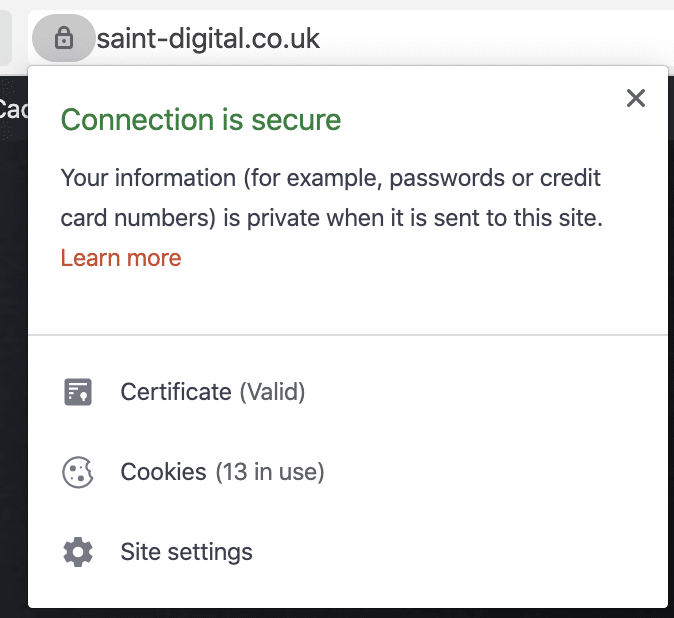
It might all seem quite complicated, but in practice all it means is that important confidential user data such as passwords will be encrypted when it is stored by the website. Even if your business doesn’t have a need for passwords, it’s still in your best interests to get secured.
Search marketers have done studies on a variety and the impact of moving from HTTP to HTTPS seems to be about a 20% increase in organic search traffic.
So, how do you get started? Most web hosts will have an option for you to pay to add the SSL certificate to be applied from their end – usually, you’ll be able to login to your hosting account and find an option to buy and apply the certificate from there.
This won’t be too expensive – your mileage may vary depending on who provides your hosting but the one we use for our site is just $15 for the year.
That’s it. A quick, simple investment for immediate SEO return – it’s not often you can say that! And you’d be surprised how few businesses still aren’t delivering fully secured web experiences, meaning you’ve got a good chance to improve your rankings across the board with one small investment.
4. GET ACTIVE – STAY ACTIVE!

Google’s mission to deliver users the most relevant websites for the search queries they use to find information. That means sites that are trusted (as we discussed, sites with quality backlinks pointing to them are more trusted). But true relevance means sites that are up-to-date, suggesting more reliable information.
It’s an increasingly important ranking factor for search engines. So let me ask you: how often do you truly update your recruitment website?
Do you use it to post your jobs, but not much more? Or do you make the common assumption that if not many people are visiting your website, it’s pointless posting there?
Let us tell you – it’s never pointless to keep your website up to date.
Whether you’re a content whiz churning out blogs and articles on your space, or simply continually adding new jobs, search engines love to see that sites are still active, and you can bet your bottom dollar that the top search results, regardless of your query, are all regularly adding new content to their websites.
Try to stay busy, as much as you can. If you have company social media accounts, use them! Write about your team’s successes, comment on industry events, and ensure the outside world knows that your agency is alive and kicking.
It’ll pay dividends in your rankings, and your organic traffic will soar too. If you don’t believe us, and you’re historically inactive, try setting yourself a challenge of updating your website regularly – even only twice a week – and keep an eye on what your search traffic does after a couple of months.
Regular updates really do matter to search engines, but they can also be great ways to build your brand, celebrate team successes to your audience, and generally make your site much more engaging. Try not to see your website as a ‘done deal’ – just like your business, it should be continually evolving and growing.
CONCLUSION
Hopefully, by this point, you’ll have a few ideas about how to ensure your recruitment website is properly optimised for you to rank highly in Google. It’s a common misconception that you need to be an expert in the most technical details of SEO to get the most results.
A solid understanding of the fundamentals can take your business a long way, and when you continually update your website, secure backlinks and post quality content, you should find that you start seeing real results within just a few months.
If you’d like to have a free consultation on your recruitment website’s current level of Search Engine Optimisation, and discover how we might be able to help you dominate the rankings for the key phrases you need to target, don’t hesitate to get in touch.


- How to redesign your site without losing SEO - December 12, 2025
- Is your business invisible to ChatGPT? The rise of Answer Engine Optimisation - December 9, 2025
- The Zombie Content Apocalypse: Why Deleting 30% of your Site Could Boost Your Traffic - December 9, 2025
GOT BIG IDEAS?
Need to step up your search marketing this year, with a water-tight plan to shoot up the rankings? Or perhaps your recruitment website isn’t converting as you’d like it to and you’re not sure how to pump up those online enquiry numbers, or the quality of candidate CVs coming through. Gotcha – we’re here to help.
Please use the form below to let us know of your grand designs and we’ll be back in touch to (hopefully) help make them happen.
