
The 3 Essentials for a Lead Generating Recruitment Website

The recruitment industry is booming, both in the UK and worldwide. Having grown consistently since 2010, it’s still showing no sign of slowing down as we enter a new decade.
Of course, high demand for recruitment services means a lot of competition in the sector for the best clients, not to mention the top-performing candidates to build the sort of network that can fill the top jobs. Indeed, in the UK, there’s been a stonking 46% year-on-year increase in recruitment company registrations since 2017.
If you’re an agency owner or considering starting your own venture in the near future, you’d be forgiven for wondering just what will set you apart from all of this competition. The answer might just be a high quality, eye-catching recruitment website. But forget all the flim-flam. The purpose of your website is to generate inbound enquiries from great clients and candidates, right?
Here are our top tips for creating a recruitment website that is going to build leads for your business, now and in the near future.
1. PUT SEO FIRST
The most important facet of your website’s lead generation capability, bar none – and many recruiters don’t even know about it! I’m talking, of course, about Search Engine Optimisation, or SEO for short.
Although it can sometimes sound arcane (and indeed, from a more technical standpoint, can sometimes be quite demanding!), the core fundamentals of SEO are quite simple. What they are are a series of best practices to ensure your website will rank highly on Google and other search engines. At the most simple level, this starts with ensuring your page links follow a logical structure. For example, on my own website, previous work pages are easily found with a logic that makes sense to humans:

The example above makes it easy for search engines to categorise the page, so if someone was to search ‘Saint Digital work’ (if only they would…), it’s pages like these that are likely to crop up for them. Do you see the little padlock to the left of our URL? That indicates that our website is SSL-secured, which means that credit card payments would be safely encrypted on the site. This is an increasingly important ranking factor, even on sites which don’t take e-commerce payments. It’s these kind of small details that will leave most recruiters behind!
Other key ranking factors include ensuring the Page Title, headings and subheadings, and body copy, all target a specific key word or phrase that you reckon your clients might just search for. But don’t be too generic with it. Where there’s not much competition for those search terms, you’re much more likely to rank, and that could mean lucrative business heading your way – without you paying a penny! As an example, let’s say you’re a Technology recruiter but you specialise in MySQL Software Engineers. Focusing your landing page design on ‘MySQL Software Engineers Recruitment’ rather than ‘Technology recruitment’ (or synonyms like technology jobs), might cover less potential approaches, but it will ensure you’ll be near the top of the rankings the next time someone with that pressing requirement does search for that expertise. And a potential new client relationship should definitely be worth the time you took to put the page together!
Whew, I hope I haven’t lost you there. Truth be told, we’re only scratching the surface of the many varied facets of SEO there are to explore. But even just having a broad and general understanding of the field will be enough to put you ahead of your competition, and the good news is that there’s lots of resources out there on the Internet to help you get to grips. AHRefs have a particularly handy guide that I’ve shared with a couple of our previous recruitment clients. It’ll give you a good foundation to begin planning future content (or content marketing, to use the industry term), for your own site.
2. CLEAR CALLS TO ACTION
Depending on your level of familiarity with online marketing, you may or may not have heard this term before. It’s one of the most crucial concepts in web design, and it’s usually one of the first things we check with our clients before commencing work: what will the Calls to Action be, where will they link to?
But let’s backpedal just a second. What is a Call to Action? In short, your business Calls to Action are going to be linked to whatever it is you want your visitors to actually do once they land on your website. For recruiters, there can only be one – OK, maybe two – answers to that question; to contact you with an enquiry or vacancy (if a client), or to submit details onto your database (if a candidate).
I could provide ample examples of Calls to Action in all kinds of sectors. It’s a fundamental concept of web design. Facebook uses them (on the registration form on its homepage to new users). Amazon uses them (on its numerous recommendations of products and services to click on). Heck, even Google uses them (the ‘Search’ button is prominent on the page and reminds them what they’re there to do!). But hey, since you’re here, let’s take a look at a couple that your humble narrator has built…

The first, a rather simple button to ‘Contact Us’, is for clients to use if they have a requirement they want to let the company know about straight away. The second is a form for Candidates to immediately join the Laz Partners network, thus ensuring they’ll be the first to know if any roles pertinent to them crop up in future. What you can’t see from just the screenshot is that we’ve also weaved a host of CTAs throughout the site. There’s clear buttons inviting the user to take action, all over the site; after the blurb on About Us, or after the Testimonials slider.
Why? Because they work! We wanted users to read about Laz Partners, and if they liked what they were reading, to then be afforded the opportunity to take action to contact the business, and begin building a productive business relationship.
Let’s take a look at another example.

If we did our job properly on Gracie Barra Harrogate, a Jiu Jitsu club, you should be able to tell us straight away what the Call to Action is. The number one goal for any business is lead generation, and for Gracie Barra, that means – you guessed it – new trials for their Jiu Jitsu class, which users need to be able to do immediately on accessing the site.
So, we put a button front and center on both the main slider, and of course as a highlight on the top bar. That means that, even as the user scrolls down the page, they’ve always got the option to get their trial booked in and get started with Jiu Jitsu, even if they’re initially only interested in finding more out about the service.
So, how do you use Calls to Action for your recruitment business? Again, it all starts with asking yourself the fundamental question, “What do we want our users to do on our website?“. Answering that question will give you a pretty good idea of what direction to go with it.
A common design decision for recruiters might be to have two buttons for the two separate audiences for the site – candidates and clients. Or another way to go about it might be to have a job search function at the top of the page for candidates, and a Menu button for Clients to find what they need (or a straightforward ‘Contact’) button. There are a whole load of different ways you might go about including CTAs on your website – but many recruiters forget that people don’t visit websites (just) to read your marketing material. They want to take action. Give them that opportunity!
3. USE LIVE CHAT TO SKYROCKET ENGAGEMENT
One of the most important search engine ranking factors is what we call bounce rate – the rate at which people leave your site immediately after first landing on a page. Uniquely amongst the metrics we typically use to measure internet success, the lower you can get this % figure, the better!
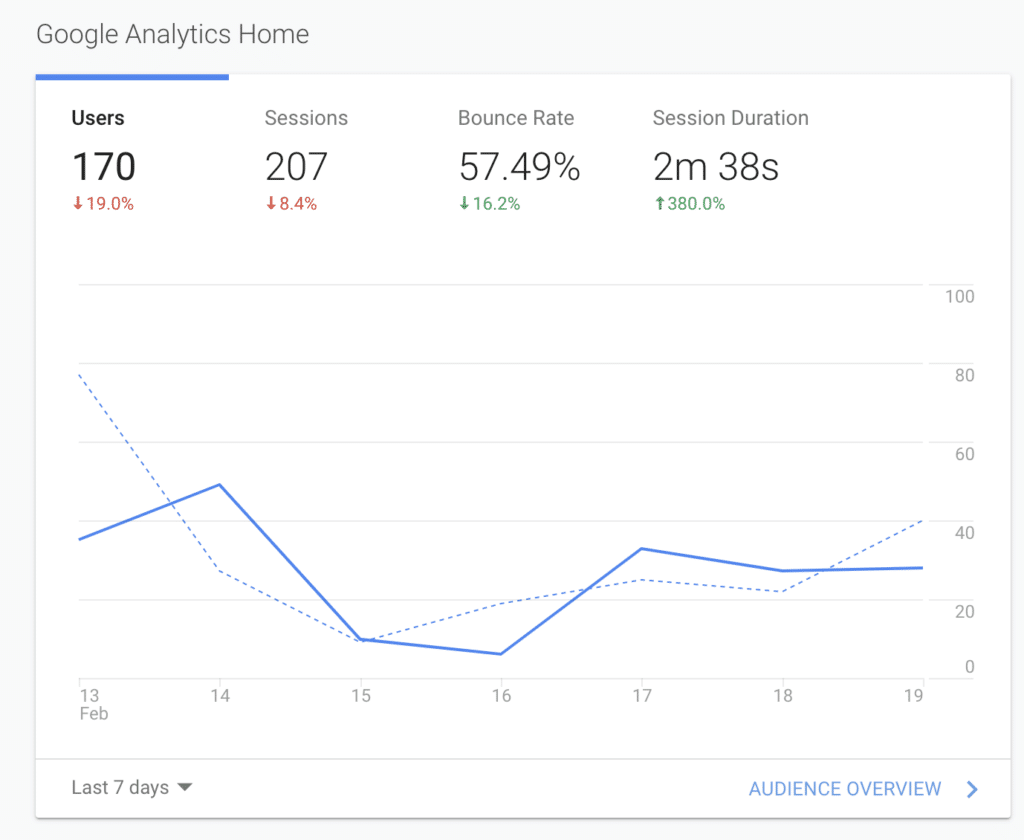
Above: our website’s stats for the last week. Hey Siri, show me a ‘mixed bag’…
As a webmaster, you need to be asking yourself why users bounce from your website. The most common reason a user will decide to search elsewhere is that they don’t feel like they’ve found what they’re looking for with your site.
And that might be down to something as simple as not knowing whether you offer the right service for their needs. Most people aren’t going to bother sending you an email and awaiting your response to ask that kind of thing. They’ll just go back to Google and see if they can find a result that seems more pertinent.
Imagine being able to reach out to those users just before they click the big red ‘X’ in the corner of their screen (or, y’know, the Back button, if you want to be pedantic about it).
You’ve just imagined a Live Chat window, sitting pretty in the bottom right hand corner of the screen, ready to assist clients and remove the barriers and roadblocks they might see to making an enquiry or uploading their details to your recruitment website!
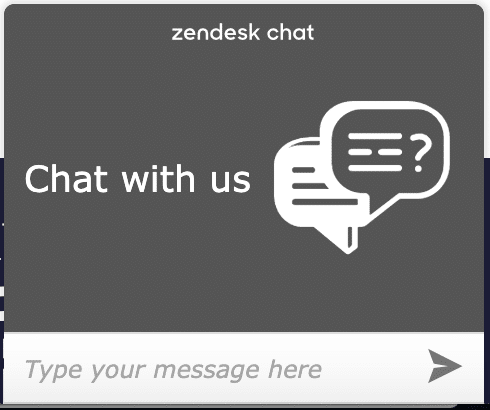
Above: a Zendesk chat window that we used for Raw Selection’s recruitment website.
It might sound like we’re exaggerating, but Live Chat functionality, if you have the time (and yes, patience) to manage and monitor it during your working hours, makes a huge impact on your user engagement, and allows you to answer the questions, and address the sticking points, of potential candidates and clients,
live while they browse your site.
Let’s imagine an example. Let’s say a client might want to know if you’ll handle a role that’s sort of in your sector, but not quite. They search for similar roles on your website, but can’t quite find them. They’re beginning to doubt whether your service is for them, after all…
Then, they noticed your Live Chat window pop up, and realised they could quickly ask you and know for sure in a matter of minutes. This is the beauty of Live Chat.
And it doesn’t end there. The questions you get asked on Live Chat will provide you invaluable insight on the typical sticking points of the people who you most want to reach – the type who will discover your website through search engines, who are much more likely to be engaged and interested in what you have to offer. That can guide future content, which in turn can lead to improved engagement, and, of course, better SEO. It’s a brilliant cycle, and the effects amount to a snowball rolling downhill, gradually becoming more and more of a recruitment machine as it goes (OK, botched that metaphor).
When you’re not online, the Live Chat will simply act as a regular contact form, and you can pick up key data like name and email address right there in the chat window, to respond to later.
And if you’d like to increase engagement, customisable triggers can be set that will automatically message all new users to your website, encouraging the kind of engagement that will help remove the roadblocks to your users from joining your network or sharing their vacancy with you.
Put bluntly, Live Chat is a no-brainer for a recruitment website, and you’ve no excuse not to get it installed pronto.
CONCLUSION
Recruitment is a highly competitive sector, there’s no doubt about that. No matter what the industry you focus upon, you’ll be one of many agencies, and you might even find yourself competing to attract the same talent, and almost definitely the same clients. But by applying some of the advice in this article, you’ll be head and shoulders above your competition when it comes to generating quality leads through your website.
Not sure where to begin? Don’t worry. Contact us and we’ll be happy to give you a free consultation on your current website, recommending key priority areas to focus upon. We can also offer web design, content marketing, SEO, PPC and branding services, filling in the gaps at your recruitment agency and helping you deliver digital excellence in a way that will make your company stand out in the best possible way.
Want to know how we deliver digital excellence for recruitment businesses?
Read about our the work we did for our most recent recruitment client, Laz Partners, here.
GOT BIG IDEAS?
Need to step up your search marketing this year, with a water-tight plan to shoot up the rankings? Or perhaps your recruitment website isn’t converting as you’d like it to and you’re not sure how to pump up those online enquiry numbers. Gotcha – we’re here to help.
Please use the form below to let us know of your grand designs and we’ll be back in touch to (hopefully) help make them happen.
