
Your Questions, Answered: Our Most Common FAQs As A Web Agency

There’s no right or wrong answers in web design, and every project is different. One of the most rewarding things in our business is to be handed an entire new challenge, or a question we’ve never even considered before, and we have to apply our experience and expertise to try to find the right answer.
Still, to be completely honest with you, when you’ve done this as long as we have, one of the things you notice is that many clients do have similar queries and sticking points prior to commencing work with us.
As we’ve got reasonably technical in some of our recent posts on this humble blog, I thought it’d be a fun diversion today to round up our most commonly asked questions in one place, in hope it might be able to help other clients of web agencies (or the simply curious) in future.
WILL I BE ABLE TO MAKE SMALL TWEAKS (AFTER WEBSITE COMPLETION)?
Yes, of course! Most web agencies today should give you that option, too, in our humble opinion – if you so choose, of course. Many business owners pay us to take the pain out of any and all website tasks, and so we’re happy to make the changes you require on your behalf.
But if you’d like to be able to amend content yourself without having to reach out to a third party (the web agency), this is more than doable. The reality is that, for the majority of requirements, making website amendments has changed from the somewhat arcane process it was, ten to fifteen years ago. Most websites now come with what’s called a Content Management System (CMS) – most commonly, this will be WordPress.
CMSes exist to make the process of adding and editing content on your website easy – or at least, much easier than they’ve ever been before. WordPress allows you to add new pages, videos, podcasts and blog posts to your website with the simple push of a button.
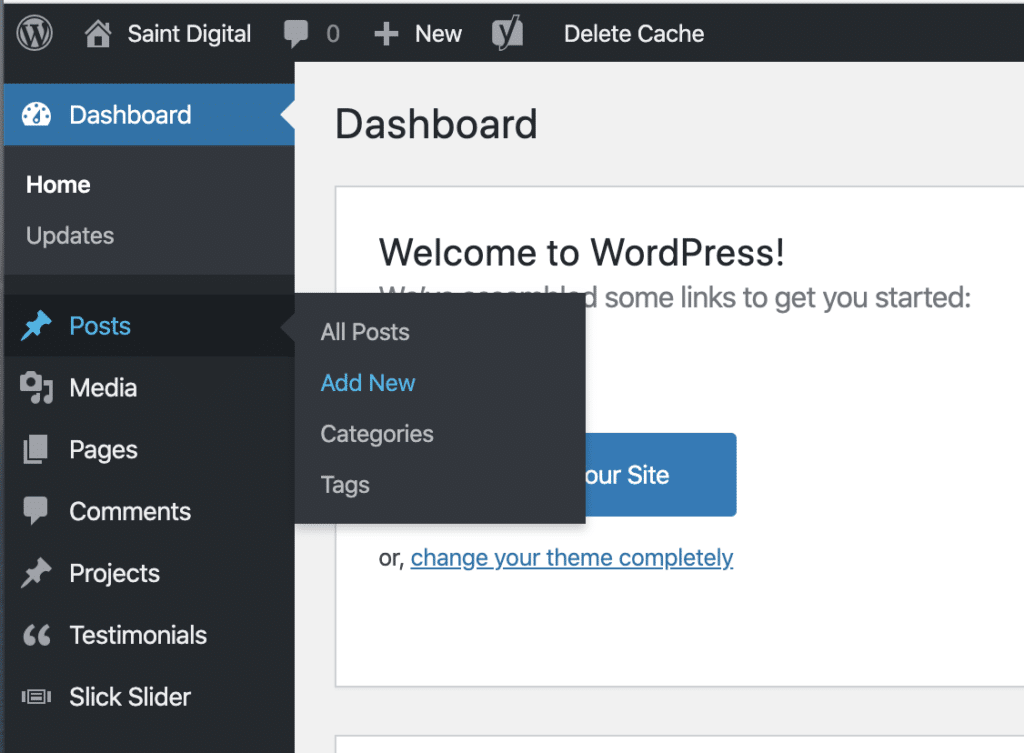
A quick snap of the WordPress dashboard for Saint Digital. This is the process I used to begin writing this very blog post, about half an hour ago!
It gets better still – several themes for WordPress (installations which change the core functionality of the platform, including your site appearance and the customisation options you have), such as Divi and Avada (both of which we use regularly in building out our designs). These themes, which each incorporate their own real-time builder – Visual Builder in the case of Divi, and Fusion Builder in the case of Avada – allow you to make small tweaks right there on your website, as if you were making tweaks to a Word Document in your browser!
If your web agency tries to keep everything locked down so you can’t make minor content tweaks, we’d (rather cheekily) suggest that you consider a new agency!
WHAT IS THE BEST HOSTING OPTION FOR ME?
This is a classic “How long is a piece of string?” type question, if you catch our drift. Many clients come to us with their own hosting arrangements, and ask us whether what they’re currently running is ‘best for them’.
But the answer is: it depends! It depends on your budget, goals for your website, the amount of memory you’re using with dynamic content like images (particularly image sliders), video, etc., and the amount of traffic your site gets.
Most people start out on shared web hosting, meaning their website is on the same server as several others. It’s a totally understandable move, because shared hosting is usually the cheapest option.
However, sometimes shared hosting can result in your site being slow – if not consistently, then some of the time (usually when other websites on the same server space are busy).
Generally, we’d take a look at the size of your site, traffic figures to your website, and consider your goals for future expansion, and make a recommendation to you.
We’ve had experience of using a fair few different web hosts and should be able to recommend one perfect for your requirements – or your current one might be just fine. The only reason you’d really want to switch is if the new website is going to be much more demanding, or if the speed of your site is already slow.
If you’d simply like a good, reliable web host that we’ve had experience in using and can recommend, we’d say for most small to mid-sized websites, you can’t go wrong with Dreamhost. And no, we promise we’re not being paid to say that! As an agency we’ve been able to rely on their support to go above and beyond at times, and it’s the web host we’re using for the site you’re browsing now, so it’s fair to say we can properly vouch for them.
Your mileage may vary, however, and it’s definitely worth investigating your options with us from the moment you decide to opt for a new website.
CAN YOU SUPPORT E-COMMERCE WEBSITES AND OTHER MORE COMPLICATED BUILDS?
This is a good and very relevant question because there’s no doubt that additional functionality, be it e-commerce or other additional functionality (such as a job search for a recruitment website, for example), makes a web project more challenging.
But yes, we can support the addition of e-commerce functionality to any of our web designs, with a bit – or indeed, a lot! – of customisation work at our end.
Generally, it’s realistic to say that the increased challenges that come with an e-commerce website will be reflected in the cost of that website to complete.

There’s a world of difference between a working online store with filter, cart, and search functionality as opposed to a brochure website (one in which you’re basically just presenting information to your users in the hope to convince them to make a buying decision). That kind of functionality affects the design decisions we have to make, and can cause other stumbling blocks when considering the responsiveness of your website – its performance on a small mobile screen, for example.
The same applies to most functionality your website will require that will go above and beyond presenting information on a page – getting them to register and have a user account on your site, for example.
And this kind of thing is just the tip of the iceberg!
It can get miles more complicated than that. Let’s say you were an online bookmaker and you need the functionality for secure financial transactions, as well as the ability to place bets in real time on the website, and for users to make their own accounts and track their bankroll… In that case, we wouldn’t be turning you away (heck, that sounds like an interesting challenge!), but the complexity of your website’s requirements would be reflected in the quote we’d give you.
HOW DOES A TYPICAL PROJECT USUALLY WORK?
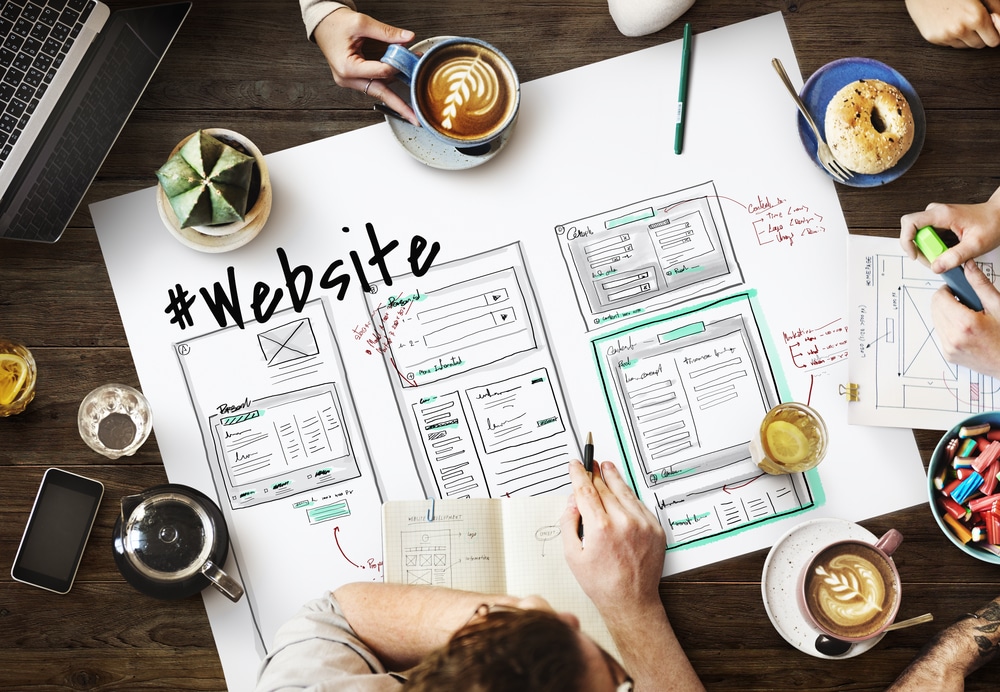
This was a tricky question to phrase as many clients will usually ask this a slightly different way. “What’s next?” is a common question we get, but obviously that wouldn’t make sense as an FAQ! So I thought it’d be useful for me to lay out how our usual build process works, from the moment a client registers their interest in potentially using our web design service, to the end product.
So, in the beginning you’ll let us know of the details of your web project, usually over an initial phone call that we’ll use to hammer out some of your initial requirements. Often, we’ll ask at this stage for links of websites that you might like or want to draw inspiration from. Obviously, we never want to plagiarise one of your close competition, but it can be handy to have a guide to go on, and might guide our initial site draft or mock-up.
On the topic of mockups, obviously if you have these, that’s great as it allows us to know exactly what we’re aiming towards! If you don’t, we can mock up how your site might look – but as this requires the time of our graphic designer, there is an additional cost. So we’ll ask you either in that initial phone call or via e-mail whether you’d like us to include the optional cost to mock up how your site will look, in the proposal.
And the proposal comes next in the process – we’ll send you a formal document which sums up your requirements as we understand them, and a costing. Generally, as a professional agency we try to lump all your costs into a flat fee, which will include troubleshooting costs for if anything goes awry during the process.
This document will also include a timescale, where we break down what we’ll deliver in each stage of the process. For example, if we think we’ll be able to complete your website in a month, we might say that in a week we’ll have a mockup ready for you. If you’re happy with the mockup, we’ll then built it out into your homepage with the main menu and footer configured by week two. At the three week mark, we’ll add more of your pages into the mix for review. By the fourth week, the site will be broadly complete and ready for testing. If both parties are happy, the launch can happen on schedule.
And that’s pretty much that! Once you sign off the proposal, we’ll do our level best to deliver everything when we say we will, and, if you can deliver prompt responses to any queries we might have, should be able to finish your website on time and to your specification.
GOT BIG IDEAS?
Need to step up your search marketing this year, with a water-tight plan to shoot up the rankings? Or perhaps your website isn’t converting as you’d like it to and you’re not sure how to pump up those online enquiry numbers. Gotcha – we’re here to help.
Please use the form below to let us know of your grand designs and we’ll be back in touch to (hopefully) help make them happen.
