
Bounce Rate

If you’ve ever looked at a Google Analytics report, you’ve seen it. It’s that one big, scary percentage that makes you feel judged: Bounce Rate.
It sounds bad. If people are “bouncing,” they must be leaving, right? And if they’re leaving, they must hate you. Right? Well… yes and no.
Welcome to the decoder ring. Bounce rate is easily one of the most misunderstood metrics in digital marketing. At Saint Digital, we see this metric not as a vanity number, but as a key diagnostic tool.
Is your design driving people away?
You have less than 3 seconds to make a first impression. If your bounce rate is high, your User Experience (UX) is likely the problem. Learn how to fix it in our guide.
What is a Bounce Rate, in Plain English?
Let’s use a real-world analogy. Imagine your website is a shop.
- A “visit” is someone walking in.
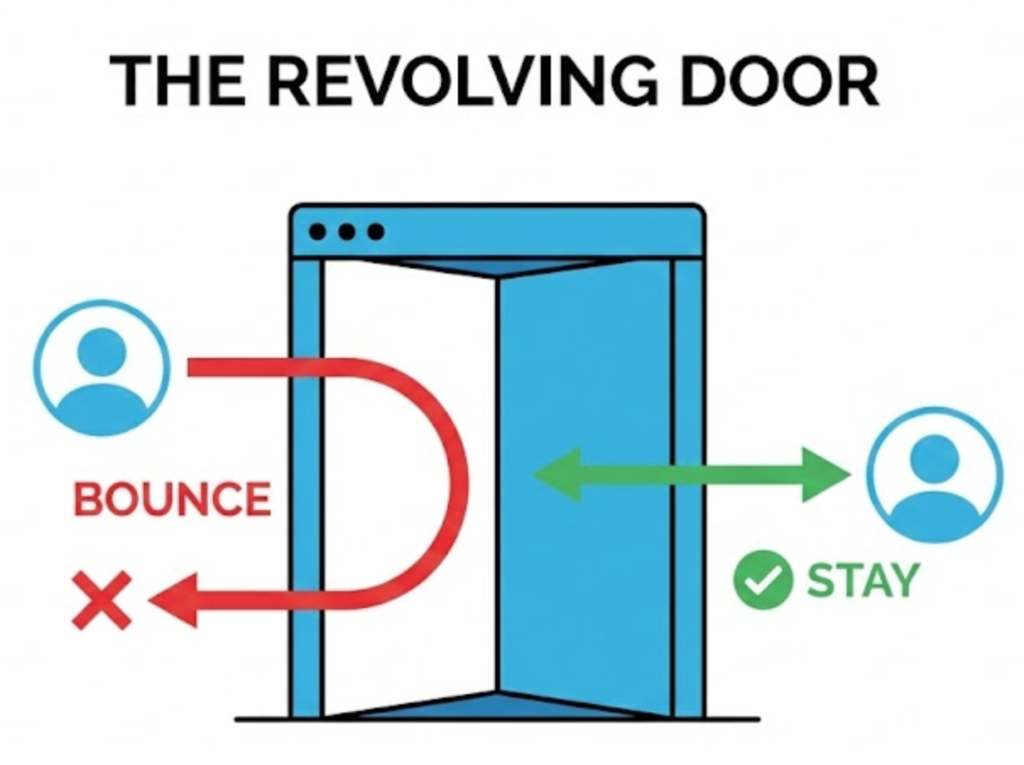
- A “bounce” is someone walking in, taking one look, saying “Nope,” and walking straight back out.
In digital terms, a bounce is a single-page session on your site. A user lands on a page and leaves without clicking on anything else.
The GA4 Update: “Engagement Rate”
Crucial Update: If you use Google Analytics 4, Bounce Rate has flipped. They now prioritize Engagement Rate.
In GA4, a session is “Engaged” if the user:
- Stays on the page for more than 10 seconds.
- Views more than one page.
- Triggers a conversion event.
If they do none of these, it is a Bounce.
Why Do People Bounce? (The “Why”)
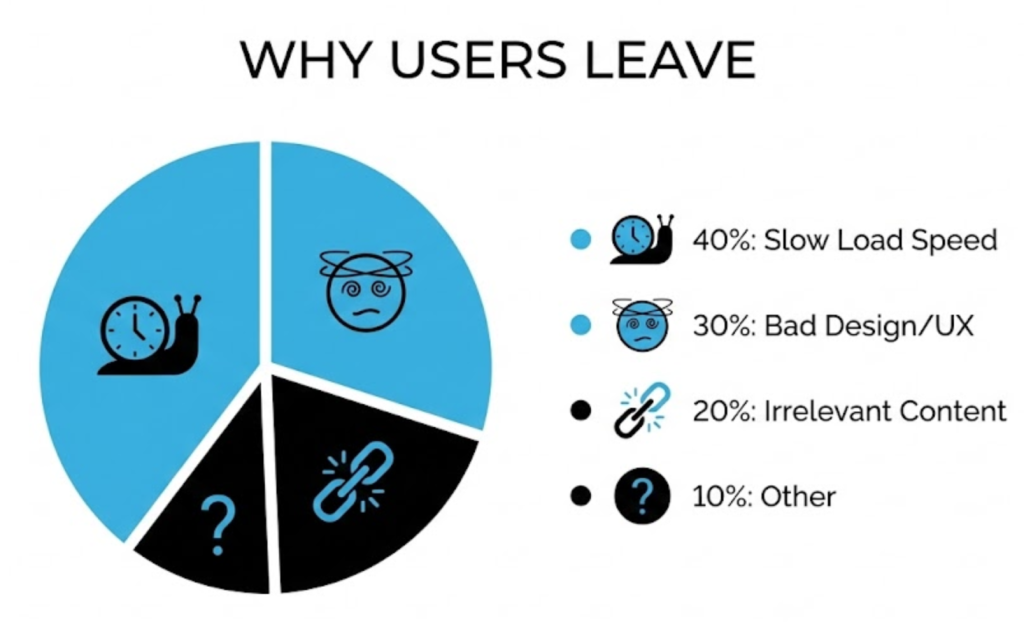
A high bounce rate is a symptom, not the disease. Here are the most common culprits.
1. Your Site is Too Slow
If your page takes more than 3-4 seconds to load, your visitor is gone. This is why we at Saint Digital are obsessed with Site Speed.
2. Your Design is a Mess (Bad UX)
If the layout is confusing, the text is too small, or pop-ups cover the screen, users will leave instantly.
3. Irrelevant Content (SEO Mismatch)
If you promised “budget web design” in Google search results but delivered a page about “premium corporate packages,” the user will bounce back to Google to find what they actually wanted.
Is a High Bounce Rate *Always* Bad?
No! Context is everything. Sometimes a high bounce rate is a sign of success.
- Example 1 (Success): A user reads your entire blog post, gets the answer, and leaves happy. GA4 counts this as a bounce (unless configured otherwise), but it was a great user experience.
- Example 2 (Success): A user lands on your Contact page, calls your phone number, and closes the tab. That’s a conversion, not a failure.
Technical Insight: Adjusted Bounce Rate
To fix the “Blog Post Problem,” we implement Adjusted Bounce Rate via Google Tag Manager.
We set a timer (e.g., 30 seconds). If a user stays longer than 30 seconds, we fire an “event.” This tells Google Analytics: “Hey, this person didn’t click anything, but they stayed long enough to read. Don’t count this as a bounce.” This gives you a much truer picture of content quality.
So… What IS a “Good” Bounce Rate?
It depends! But as a very general rule of thumb:
- 25% – 40% (Excellent): Users are highly engaged.
- 40% – 55% (Average): Common for most websites.
- 70% + (High): Unless it’s a blog, this signals a problem with design or speed.
The Takeaway
Don’t look at your bounce rate as a “pass/fail” grade. Look at it as a health check.
Diagnosing why people are bouncing is part art, part science. It’s about understanding User Psychology and having a rock-solid technical setup.
At Saint Digital, our web design services focus on creating “sticky” experiences that keep users engaged.
If you’re staring at a high bounce rate and don’t know where to start, let’s have a chat.
REPELLING YOUR VISITORS?
A high bounce rate is just a symptom. It’s your website’s way of telling you that something—speed, design, or messaging—is wrong.
Don’t guess what the problem is. We at Saint Digital are experts at diagnosing why users are leaving. Let’s have a chat and turn those “bounces” into “conversions.
Learn more from our Glossary
© Saint Digital Ltd, 2020-26, all rights reserved.