
Dwell Time

What is Dwell Time? (The “Stickiness” of Your Website)
You rank #1 on Google. A user clicks your link. Five seconds later, they hit the “back” button and click on your competitor instead.
You just lost more than a visitor. You sent a signal to Google that your page is irrelevant.
This is the concept of Dwell Time.
Welcome to the decoder ring. Dwell Time is the length of time a visitor spends on a page before returning to the search engine results page (SERP). It is a critical proxy for relevance and quality. At Saint Digital, we don’t just optimize for clicks; we optimize for attention.
Are users leaving your site too fast?
You can trick a user into clicking, but you can’t trick them into staying. High Dwell Time comes from great content and great UX. Our Beginner’s Guide explains how to master both.
The Difference: Dwell Time vs. Bounce Rate
These metrics sound the same, but they are very different.
1. Bounce Rate (Analytics Metric)
A “Bounce” is when a user visits a page and leaves without clicking anything else. The Catch: A user could read your entire 2,000-word article for 10 minutes and then leave. That is a “Bounce,” but it was a successful visit.
2. Dwell Time (Ranking Signal)
This is specific to Search Engines. It measures the gap between clicking a blue link on Google and clicking the “Back” button to return to Google.
Why Dwell Time Matters (The “Pogo-Sticking” Problem)
If users constantly click your link and immediately bounce back, this behavior is called Pogo-Sticking.
Pogo-Sticking screams to Google: “This result was not what I wanted!” If this happens enough, Google will demote your rankings. Conversely, if users click your link and stay, it tells Google you are the correct answer.
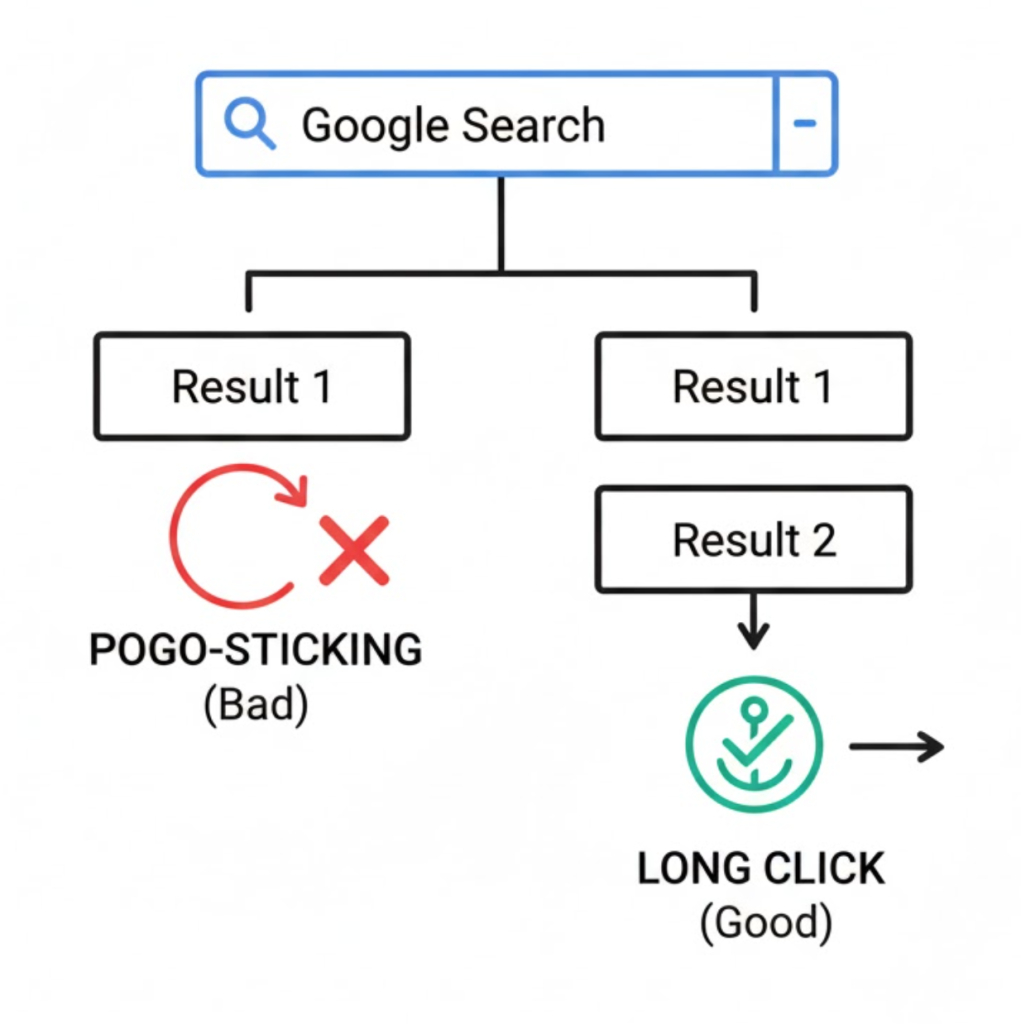
Technical Insight: The “Long Click” (Navboost)
For years, Google denied using clicks as a ranking factor. However, recent leaks (specifically the Navboost system) confirmed that Google tracks “successful clicks.”
In Google’s internal code, they look for a “Long Click.” This is when a user clicks a result and stays away from the search page for a significant amount of time. Optimizing for Dwell Time is essentially optimizing for this “Long Click” metric.
How to Increase Dwell Time (The “Hook and Flow”)
How do we keep users on the page? We use a strategy called “The Hook and The Flow.”
1. Nail the “Above the Fold” Experience
If your page loads slowly or is covered in ads, users leave in 3 seconds. Ensure your headline (H1) matches the user’s search query perfectly.
2. The “APP” Formula for Intros
Don’t waffle. Agree (State the problem), Promise (Offer the solution), and Preview (Show what’s coming). This hooks the reader instantly.
3. The “Video Cheat Code”
This is the ultimate hack. Embedding a video keeps users on the page. If a user stops to watch a 2-minute video, your Dwell Time instantly jumps to 2+ minutes.
The Takeaway
Dwell Time is the best proxy we have for “User Satisfaction.” You can trick a user into clicking a title tag, but you can’t trick them into staying. You have to earn their attention.
At Saint Digital, our web design services combine fast technical performance with engaging content that holds the reader’s attention.
Are your visitors leaving too soon? Let’s fix your flow.
Stop the “Pogo-Stick”
Getting the click is only half the battle. If users leave instantly, you lose. We at Saint Digital create engaging, sticky content experiences. We optimize your layout, speed, and copy to keep users reading, watching, and converting.
Let’s capture their attention.
Learn more from our Glossary
© Saint Digital Ltd, 2020-26, all rights reserved.