
Algorithm

What is the Google Algorithm? (The Librarian of the Internet)
Let’s be honest, the “Google Algorithm” sounds like a big, scary, super-secret thing, doesn’t it?
It’s the term that gets thrown around in marketing meetings to confuse everyone. You’ve probably heard someone say, “We need to do this for the algorithm,” and everyone just nods slowly, pretending they know what that means.
Well, welcome to the decoder ring. The good news is, it’s not as scary as it sounds. At its core, the Google algorithm isn’t a single thing. It’s a giant, complex rulebook.
Think of it this way: The internet is the biggest, most chaotic library in human history. Billions of books (pages) are being added every day, with no central filing system.
Google is the super-librarian. The algorithm is its brain. It’s the set of rules and calculations it uses to sift through trillions of pages in a fraction of a second and give you the best possible answer to your question.
Stop chasing every update.
Google changes its algorithm thousands of times a year, but the core principles remain the same. Learn the fundamental rules of visibility in our comprehensive guide.
How Does the Google Algorithm Even Work?
You don’t need to be a rocket scientist to get the basics. The whole process works in three main steps.
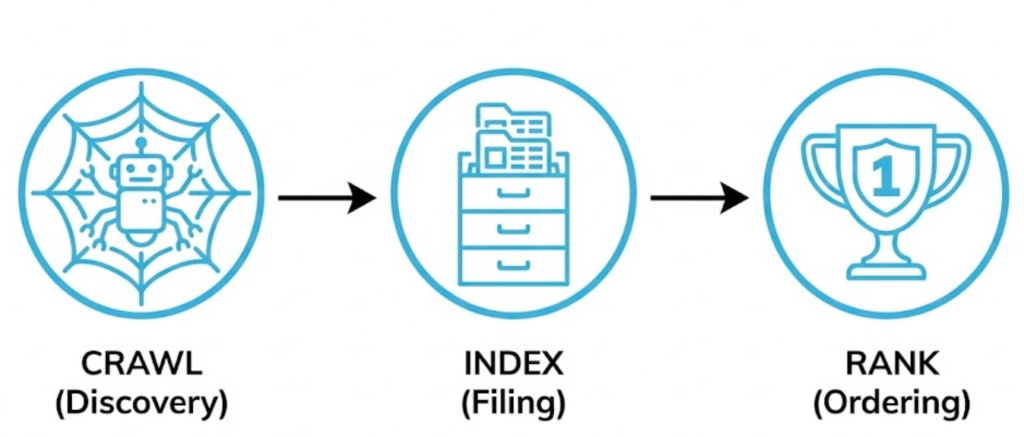
Step 1: Crawling (Finding the Pages)
First, Google has to find all those books in the giant library. It does this using “spiders” or “bots.” These spiders “crawl” the internet 24/7 by following links, discovering new pages and reporting back.
Step 2: Indexing (Understanding the Pages)
Finding the page isn’t enough. The librarian actually has to read it. In this step, Google analyses the page—words, images, code—and files it away in a gigantic digital catalogue called “the Index.” When you search on Google, you’re not searching the live internet; you’re searching this Index.
Step 3: Ranking (Serving the Best Pages)
This is the magic moment. When you type “best lasagne recipe,” Google zooms to its Index and asks, “Of the 50 million pages I have, which ones are the best?” To decide that, it consults its rulebook.
What Are These “Rules”? Meet the Ranking Factors
Google uses over 200 “ranking factors” to decide the order. Nobody knows all of them, but we know the big ones.
1. Meaning & Relevance
If you search for “lasagne,” the algorithm looks for pages about lasagne. But it’s smart. It understands synonyms (like “pasta bake”) and concepts. It knows that a page with ingredients and reviews is more relevant than a page that just mentions the word 100 times.
2. Quality (E-E-A-T)
Google wants a good answer. It uses a concept called E-E-A-T:
- Experience: Does the author have first-hand experience?
- Expertise: Is the author an expert?
- Authoritativeness: Is this website a respected source?
- Trust: Is this site secure and accurate?
3. Usability (UX)
Google wants to send users to websites they’ll enjoy using. Does your website load fast? Is it mobile-friendly? A huge part of our web design work is making sure your site makes the algorithm happy by making humans happy.
4. Backlinks (Votes)
The algorithm sees a link from another website to yours as a “vote.” If a big, trusted website links to you, Google sees that as a massive vote of confidence. Backlinks are a sign of authority.
Technical Insight: RankBrain (The AI Revolution)
In 2015, Google introduced RankBrain. This was the game-changer.
Before RankBrain, the algorithm was rigid. After RankBrain, it became an AI that “learns.” RankBrain looks at how users interact with results. If everyone clicks the #1 result but immediately bounces back because it wasn’t helpful, RankBrain learns that result is bad and demotes it. It focuses on User Intent over keywords.
The “Core Update” Reality
You’re not wrong. Google updates its algorithm thousands of times a year. Most are tiny tweaks.
But a few times a year, they release a “Core Update.” These are the big ones that shake up rankings. It’s Google’s way of refining its rulebook to weed out spam.
The only way to win at SEO in the long run is to stop trying to “trick” the algorithm and just… be the best answer.
The Takeaway
The algorithm isn’t a scary monster under the bed. It’s just a set of rules designed to reward quality.
It’s a lot to think about, we know. But the good news is, it’s our entire job to handle that for you at Saint Digital!
At Saint Digital, our SEO services focus on building high-quality, technically sound websites that align perfectly with what the algorithm wants: a great experience for the user.
Ready to get on Google’s good side?
GOT BIG IDEAS?
It’s a lot to take in, isn’t it? The good news is, you don’t have to worry about E-E-A-T or Core Updates. That’s our job. If you’d rather focus on running your business than on Google’s rulebook, let us handle the techy stuff.
Drop your details in the form below for a simple, jargon-free chat about your website.
Learn more from our Glossary
© Saint Digital Ltd, 2020-26, all rights reserved.