
Local SEO

What is Local SEO? (How to Win the “Map Pack” and Own Your Area)
If you run a coffee shop in Leeds, you frankly don’t care if someone in New York finds your website. In fact, that traffic is useless to you. You care if someone two streets away finds you when they type “best coffee near me.”
Standard SEO is about ranking globally. Local SEO is about ranking right where you live.
It is the strategic process of optimising your online presence to attract more business from relevant local searches. For brick-and-mortar businesses (shops, restaurants) or service area businesses (plumbers, electricians), it is the single most profitable marketing channel in existence.
Why? Because of Intent.
When someone searches for “plumber,” “Italian restaurant,” or “web designer” on their phone, they have extremely high Transactional Intent. They aren’t just browsing or looking for a definition; they are ready to buy, visit, or call right now.
At Saint Digital, we treat Local SEO as a completely separate discipline from traditional SEO. It has different rules, different ranking factors, and a different prize: The Map Pack.
Dominate your local market.
Local SEO requires a mix of technical precision, reputation management, and citation building. Learn the complete framework for ranking in your area in our comprehensive guide.
The Prize: The “Map Pack” (Local Pack)
When you Google a local service, you don’t see the normal blue links first. You see a map with three specific business listings underneath it.
This is called the Local Pack (or Map Pack).
It appears at the very top of the search results, stealing nearly all the attention and clicks. In fact, studies show that the “3-Pack” captures over 44% of all clicks for local queries.
Crucially, the algorithm that decides who gets into these three spots is different from the main Google algorithm. You can rank #1 organically (in the blue links) but still be invisible on the map. To win here, you need a specific strategy.
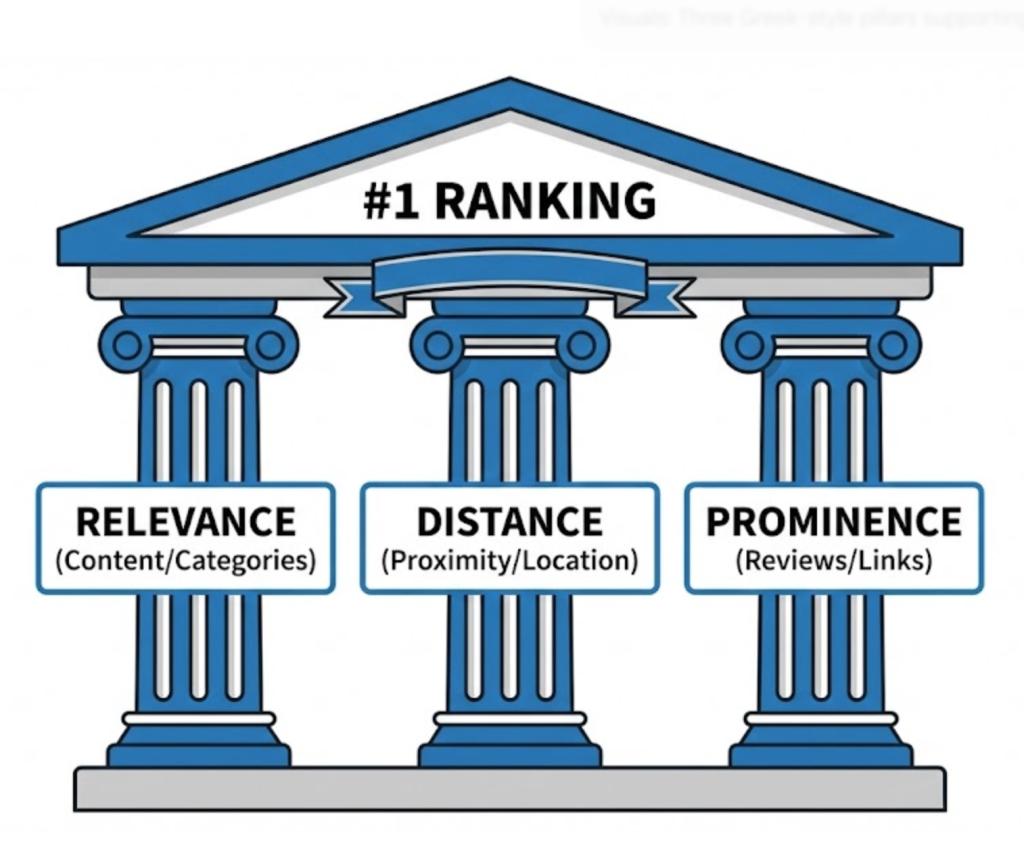
The 3 Pillars of Local Ranking
Google has explicitly stated the three core factors it uses to rank businesses locally. Think of these as a three-legged stool; if one is missing, you fall over.
1. Relevance (“Do you do what I need?”)
Google asks: “Does this business do exactly what the user is searching for?”
If a user searches for “Emergency Boiler Repair,” Google won’t show a generic “Handyman” profile. It looks for specific relevance signals in your business categories, your business title, and the content on your website. This is why Keyword Research is still vital locally.
2. Distance (“Are you close enough?”)
Google asks: “How close is this business to the searcher’s physical location?”
This is the one factor you cannot control (unless you move your office!). Google uses the user’s GPS data. However, you can influence this for “Service Area Businesses” by creating specific “Location Pages” on your site for the nearby towns you serve.
3. Prominence (“Do people trust you?”)
Google asks: “How well-known and trusted is this business in the real world?”
This is the big one. This is where Saint Digital does the heavy lifting. Prominence is calculated based on:
- Review Count & Score: 4.8 stars with 100 reviews beats 5.0 stars with 2 reviews.
- Backlinks: Links from other local sources (local news, chambers of commerce, local directories) carry huge weight.
- Citations: Mentions of your business name across the web.
The Engine Room: Google Business Profile (GBP)
Formerly known as “Google My Business,” your Google Business Profile (GBP) is your Home Base. It is not just a listing; it is an interactive social profile for your company.
To rank in the Map Pack, simply “claiming” it isn’t enough. You must optimize it:
- Categories: Choose the primary category carefully (e.g., “Marketing Agency” vs “Internet Marketing Service”).
- Photos: Upload real photos of your team, office, and work. Profiles with photos get 42% more requests for directions.
- Updates: Use the “Google Posts” feature to share news and offers, signaling to Google that you are active.
- Q&A: Seed your own Q&A section with common customer questions to provide relevance.
The Foundation: NAP Consistency
NAP stands for Name, Address, Phone Number.
Google is paranoid. It wants to be 100% sure your data is correct before it sends a user to your door. If your website says “123 Main St,” but your Facebook page says “123 Main Street, Suite 4,” and Yell.com lists an old phone number, Google gets confused.
Inconsistent data kills local rankings.
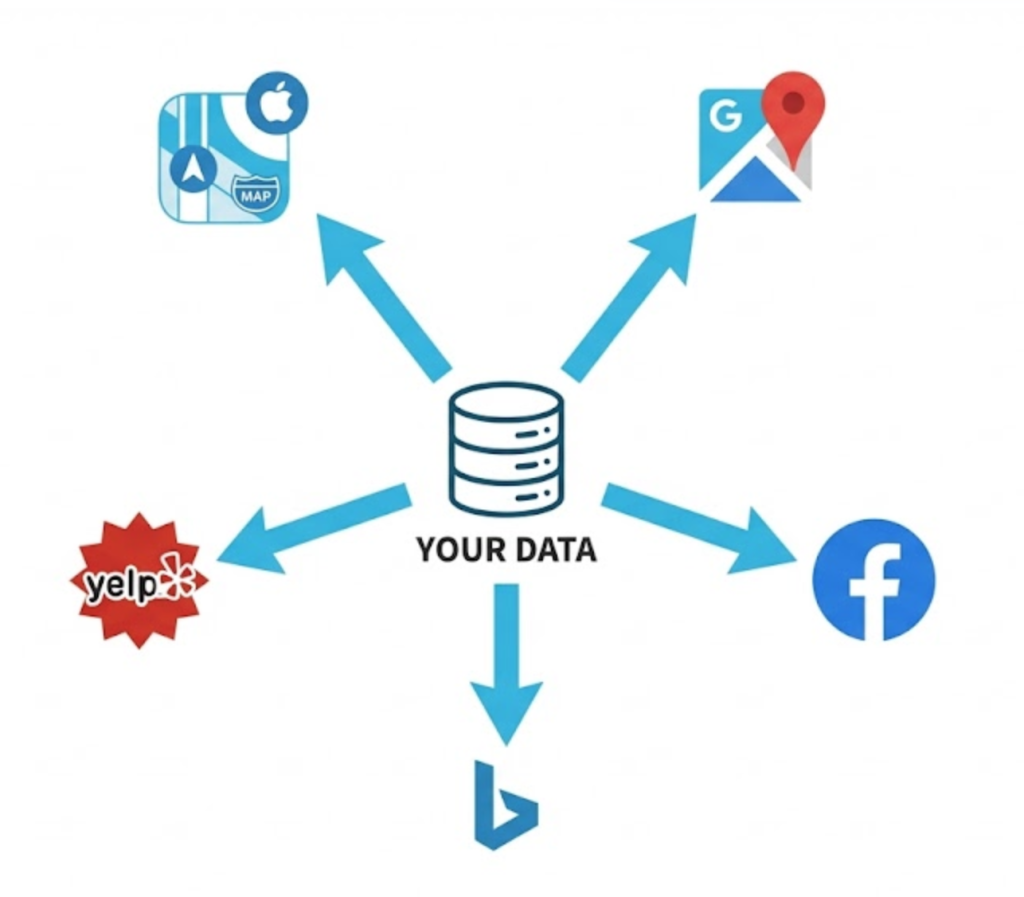
We perform “Citation Cleanup” audits. We scour the Data Aggregators (the big databases that feed Apple Maps, Bing, and Yelp) to ensure your NAP is identical down to the last character across the entire digital ecosystem.
The “Near Me” Phenomenon & Reviews
Reviews are a direct ranking factor. Google explicitly rewards businesses with a high volume of positive, recent reviews.
But it goes deeper. The text of the reviews matters. If a customer writes, “They did a great job fixing my leaking tap,” Google reads that keyword and connects it to your profile. Suddenly, you are more likely to rank for “leaking tap repair near me.”
We help clients build “Review Generation” strategies, sending automated SMS or email prompts to happy customers to build this digital wall of trust.
Technical Local SEO: Speaking the Language
This is the technical edge. We add “LocalBusiness” JSON-LD Schema to your website’s code.
This tells Google’s robots—in their own language—exactly where you are located, what your coordinates are (Latitude/Longitude), and what areas you serve. It connects your website to your GBP, creating a unified “Entity” in the Knowledge Graph.
Warning: Location Pages vs. Doorway Pages
A common mistake is creating 50 nearly identical pages for every town in the UK (e.g., “Web Design Leeds,” “Web Design Bradford,” “Web Design Wakefield”) with just the city name swapped.
Google calls these Doorway Pages. It is a spam tactic that can get your site penalized.
The Saint Digital Approach: If you want to rank in a neighboring town, you must build a unique Location Page. It needs unique content about that area—mentioning local landmarks, local case studies, or specific reviews from clients in that town. It must offer genuine value, not just keyword stuffing.
The Takeaway
Local SEO isn’t just about “being found.” It’s about being found by the people who are standing on your doorstep with money in their hand.
It requires a different skillset than regular SEO. It’s less about global volume and more about local relevance, accurate data, and building a trusted reputation in your community.
At Saint Digital, we put you on the map. Literally. We handle the messy data cleanup, the technical schema, and the profile optimisation so you can focus on serving the customers walking through your door.
Ready to dominate your local area?
Are you invisible locally?
If you aren’t in the “Map Pack,” you are handing customers to your competitors. We at Saint Digital are Local SEO specialists.
We clean up your data, optimize your profile, and build the local authority you need to own your area.
Learn more from our Glossary
© Saint Digital Ltd, 2020-26, all rights reserved.