
Natural Language Processing (NLP)

What is NLP? (Teaching Computers to Read Minds)
If you have ever asked Siri for the weather, used Google Translate to order a coffee in Spain, or had a customer service chatbot actually solve your problem, you have interacted with Natural Language Processing (NLP).
Natural Language Processing is the branch of artificial intelligence that gives computers the ability to understand, interpret, and generate human language in the same way human beings can.
For decades, computers were dumb. They could only understand code—rigid, structured commands (zeros and ones). Human language, by contrast, is messy, ambiguous, emotional, and full of slang. NLP is the bridge that allows a machine to “read” a sentence, understand the sentiment and intent behind it, and formulate a logical response.
In the world of digital marketing, NLP is the engine behind modern SEO. It is the reason we no longer have to type “weather London” like a caveman, but can instead ask, “Will I need an umbrella in London today?”
Write for humans, rank for robots.
Google’s AI now understands nuance, context, and sentiment. To rank today, your content must be clear, structured, and authoritative. Learn the fundamentals in our complete guide.
How NLP Works: Breaking the Code
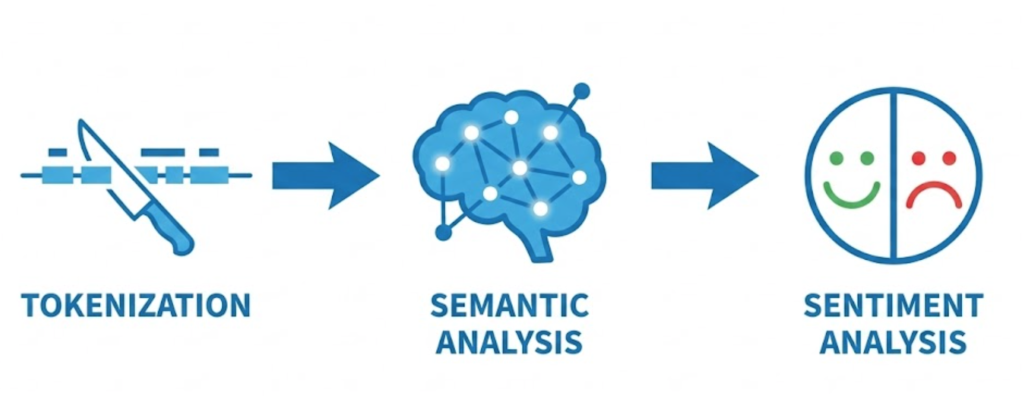
To a computer, the sentence “I love Apple products” looks just like a string of random characters. It has no inherent meaning. To understand it, NLP breaks the process down into several complex layers.
Step 1: Tokenization (The Chop)
The machine first chops the text into smaller units called “tokens.” In the sentence above, “Apple” becomes a distinct token. This is the foundational step of how AI reads.
Step 2: Semantic Analysis (The Meaning)
This is where it gets difficult. The computer sees the token “Apple.” It has to decide: Is this the fruit? Or is this the technology company?
Through Vector Search and context analysis, the NLP model looks at the surrounding words. Because the word “products” appears nearby, the probability shifts. It determines you are referring to the tech giant, not the fruit.
Step 3: Sentiment Analysis (The Emotion)
Finally, the machine assesses the emotion. It identifies the word “love” as a positive indicator. Thus, the computer understands:
- Subject: Apple (Organization)
- Sentiment: Positive (+0.9 Score)
- Intent: Appreciation / Commercial Interest
Syntax vs. Semantics (The Two Pillars)
To optimize your website for NLP, you must understand the two pillars of language processing:
- Syntax (The Grammar): This refers to the arrangement of words. NLP algorithms use “parsing” to check if a sentence follows grammatical rules. If your website content is poorly written or grammatically broken, Google’s NLP models may struggle to index it correctly.
- Semantics (The Meaning): This is the logic behind the words. “Colorless green ideas sleep furiously” is a sentence that is syntactically correct (the grammar is fine) but semantically nonsensical. Google’s modern updates (like BERT) are obsessed with Semantics—they want to know if your content actually makes sense.
NLP in Google Search (Why Keywords Died)
Google has been integrating NLP into its core ranking systems for years. This evolution helps explain why “old school” SEO tactics no longer work.
BERT and Hummingbird
The Hummingbird update (2013) and BERT (2019) were Google’s massive leaps into NLP. Before these, you could rank a page by repeating a keyword 50 times. After these updates, Google started reading the paragraphs. If you repeated a keyword unnaturally, the NLP model would flag the syntax as “unnatural” and downgrade your ranking.
Entity Recognition (NER)
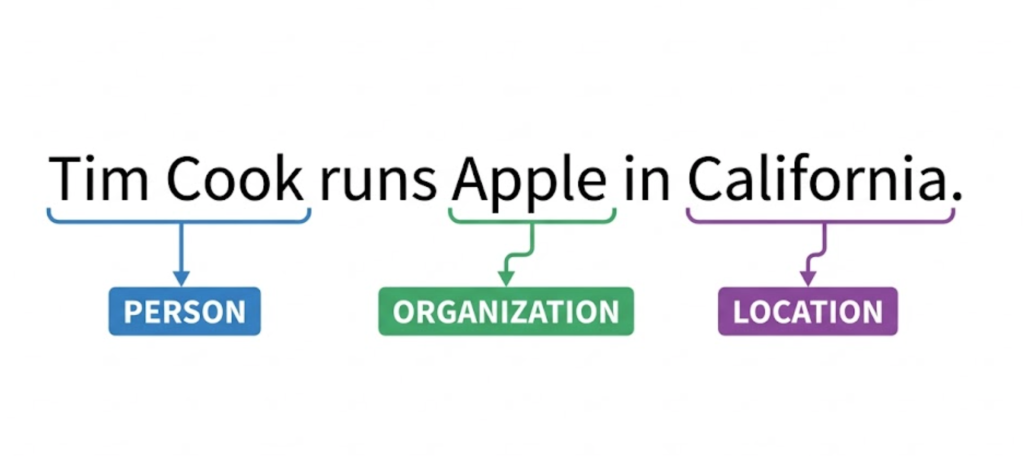
Named Entity Recognition (NER) is a sub-task of NLP. It looks for “Entities” (People, Places, Organizations). If you want to rank for “Best Pizza in Leeds,” Google’s NLP looks for related entities on your page like “Wood Fired,” “Dough,” “Italian,” and “West Yorkshire.” It builds a web of relevance based on the vocabulary used by experts in that field.
Technical Metric: The “Salience” Score
Google provides a demo of its NLP API where you can see exactly how it views your text. One of the key metrics is Salience.
Salience measures how important a specific word is to the overall meaning of the text. (Range: 0.0 to 1.0)
The Trap: If you write a 1,000-word article about “Web Design,” but you wander off-topic and talk about your office dog or the weather for 500 words, the Salience score for “Web Design” drops. The NLP model concludes: “This article mentions web design, but it isn’t strictly about web design.”
The Strategy: Keep your content focused. Use a semantic content structure (H2s and H3s) that keeps the “Salience” of your main topic high throughout the entire page.
NLP and Sentiment Analysis (Reviews Matter)
NLP isn’t just for your website text; it’s for your Reviews too.
Google runs Sentiment Analysis on your Google Maps reviews. It doesn’t just look at the star rating; it reads the adjectives.
- “The staff were rude and slow.” (Negative Sentiment Entity: Staff)
- “The pizza was delicious and crispy.” (Positive Sentiment Entity: Pizza)
If enough people mention “crispy” positively, Google will start ranking you higher for “Crispy Pizza.” This is why getting detailed, descriptive reviews is a powerful SEO strategy.
The Takeaway
Natural Language Processing has democratized technology. It allows us to speak to machines as if they were people. For business owners, it means the days of “gaming the system” are over.
To win in an NLP world, you don’t need to be a computer scientist. You just need to be a great communicator. Clear, concise, and authoritative writing is now the ultimate ranking factor.
If your current agency is still sending you text filled with awkward keywords and robotic phrasing, they are optimizing for 2010, not the AI era. At Saint Digital, we craft content strategies backed by modern NLP principles.
Is your website speaking Google’s language?
Natural Language Processing means search engines now read like humans. If your content is stuffed with keywords instead of natural conversation, you are losing rank.
Let’s chat about how to make NLP work for your business.
Learn more from our Glossary
© Saint Digital Ltd, 2020-26, all rights reserved.