
Vector Search

What is Vector Search? (The Engine Behind the AI Revolution)
If you have ever wondered how Spotify knows exactly which song you want to hear next, or how Google can answer a question even when you don’t use the “right” keywords, the answer is Vector Search.
For decades, the internet ran on “keyword matching.” If you searched for “running shoes,” search engines looked for pages that contained the words “running” and “shoes.” But language is messy. It is full of synonyms, slang, and nuance.
Vector Search is the technological leap that allows machines to understand meaning rather than just syntax. It is the backbone of modern Artificial Intelligence, powering everything from ChatGPT to Google’s AI Overviews.
In this guide, we will break down exactly how Vector Search works, why it has made old-school SEO tactics obsolete, and how you can optimize your content for a semantic world.
Stop optimizing for keywords, start optimizing for meaning.
Google’s AI now understands intent better than ever. If your content is stuck in the keyword-stuffing era, you are invisible. Learn how to align your strategy with modern semantic search in our complete guide.
The Old Way: Lexical Search Explained
To understand the future, we must look at the past. Before Vector Search, we had Lexical Search.
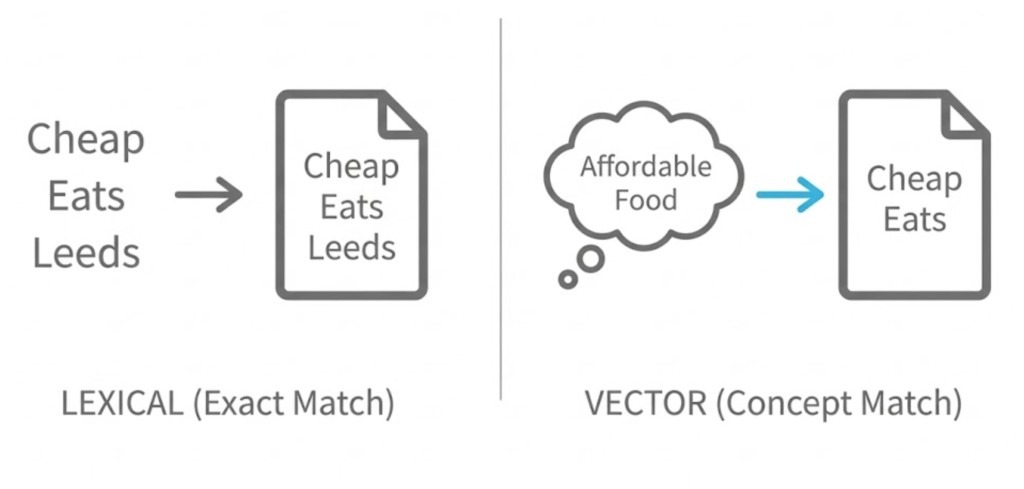
Lexical search is literal. It maps the query directly to documents in an inverted index.
- User searches: “Cheap places to eat in Leeds”
- Engine looks for: Documents containing “Cheap” + “Places” + “Eat” + “Leeds”
The problem? If a blog post was titled “Affordable Dining Spots in West Yorkshire,” a strict lexical search might miss it entirely. Even though the intent is identical, the keywords don’t match. This led to years of Keyword Stuffing.
What is Vector Search? (The “Space” Analogy)
Vector Search (also known as Semantic Search) doesn’t look for matching words. It looks for matching concepts.
It works by translating data—whether that is text, images, or audio—into lists of numbers called Vectors (or Embeddings). These numbers represent the “meaning” of the content in a multi-dimensional mathematical space.
Visualizing the “Vector Space”
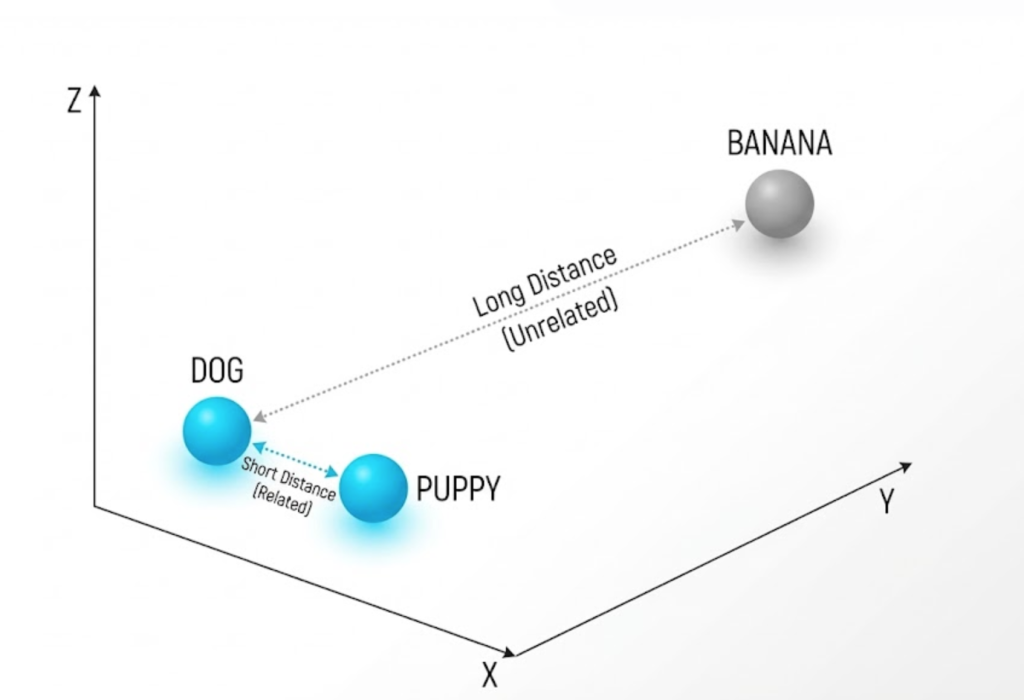
Imagine a 3D graph (X, Y, and Z axes). The AI assigns coordinates to every concept based on its relationship to other concepts.
- Concept A (Dog): Might be located at coordinates
[10, 5, 2]. - Concept B (Puppy): Might be located at
[10, 5, 3]—right next to “Dog.” - Concept C (Banana): Might be located at
[2, 90, 50]—far away in a different corner of the graph.
In this system, the search engine calculates the distance between points. It knows that “Dog” and “Puppy” are semantically close, while “Dog” and “Banana” are unrelated.
Now, expand that simple 3D graph into 1,000 dimensions. That is a Vector Space. It captures complex relationships like:
“King” – “Man” + “Woman” = “Queen”
The AI understands that the relationship between “King” and “Man” is the same as the relationship between “Queen” and “Woman,” purely based on their position in the vector space.
Technical Insight: Embeddings and Cosine Similarity
How does the computer measure “closeness”? It uses a mathematical formula called Cosine Similarity.
It measures the angle between two vectors. If the angle is small (close to 0 degrees), the concepts are nearly identical. If the angle is 90 degrees, they are unrelated. If the angle is 180 degrees, they are opposites.
This process of turning text into a vector is called generating an Embedding. This is what Large Language Models (LLMs) do. When you search, Google converts your query into an embedding and runs an algorithm called K-Nearest Neighbors (KNN) to find the documents mathematically closest to your query.
How Vector Search Changed Google Forever
Google has been slowly transitioning from a “Lexical Engine” to a “Vector Engine” for a decade. This evolution is why modern SEO requires high-quality, comprehensive content.
The Timeline of Understanding
- 2013: Hummingbird. The first step. Google started looking at the whole query rather than individual words.
- 2015: RankBrain. Google introduced machine learning to handle unseen queries. RankBrain used early vector concepts to guess the meaning of ambiguous words.
- 2019: BERT. A massive leap. BERT allowed Google to read words in context of the words around them. It understood that “stand for” is different from “stand by.”
- 2024: AI Overviews (SGE). Today, Google isn’t just retrieving links; it is generating answers. This is purely powered by vector-based LLMs that synthesize an answer based on topical proximity.
Hybrid Search: The Best of Both Worlds
Is the keyword dead? Not quite.
Modern search engines use Hybrid Search. They combine Vector Search (for understanding intent) with Lexical Search (for precision).
Example: If you search for a specific part number like “Nvidia RTX 4090,” you don’t want a “conceptually similar” graphics card. You want that exact card. Google uses Lexical search for the part number, and Vector search for the context.
How Vectors Handle “Ambiguity”
One of the superpowers of Vector Search is Disambiguation. Take the word “Bank.”
- “I went to the bank to deposit money.” (Financial Institution)
- “I sat on the river bank.” (Landform)
In a Lexical search, a document about rivers might accidentally rank for a query about mortgages because they both contain the word “Bank.”
In a Vector search, the surrounding context words pull the vector in completely different directions. The “Financial Bank” vector lives in a totally different neighborhood of the map than the “River Bank” vector. The search engine never confuses them.
The Implications for SEO (How to Rank)
So, if Google is using vectors, how do you optimize for it? You cannot “edit” your vector coordinates directly. However, you can influence where your content sits on the map.
1. Focus on “Entities,” Not Just Keywords
An Entity is a distinct concept—a person, place, or thing. Instead of repeating the phrase “Best Pizza,” write content that discusses related entities like “Wood-fired,” “Sourdough,” and “Italian Ingredients.” This builds a rich “Context Vector.”
2. Topical Authority is King
Vector search rewards depth. If your website covers a topic from every angle, your site’s overall “Vector” becomes strong in that area. This is why we recommend Pillar Pages and Topic Clusters.
3. Answer the User Intent
Vectors are mapped by Search Intent. Even if two pages share similar keywords, they exist in different vector spaces if one is informational and the other is transactional. Ensure your content format matches what the user is actually trying to achieve.
Beyond Text: Multimodal Search
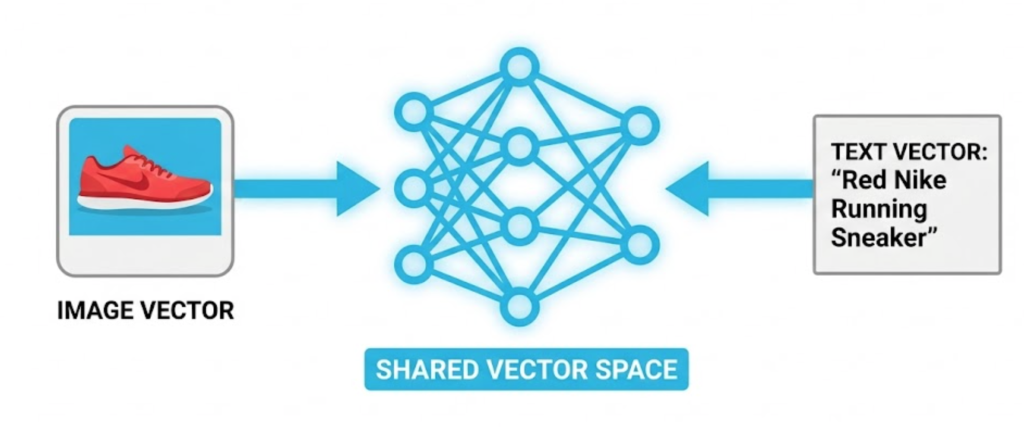
The most exciting frontier of Vector Search is that it is “Multimodal.” This means text and images live in the same map.
Have you ever used Google Lens? You take a picture of a shoe, and Google finds where to buy it. This works because the Image Vector of the shoe is mathematically similar to the Text Vector of the product description “Red Nike Running Sneaker.” This makes Alt Text and image optimization more critical than ever.
The Takeaway
Vector Search is not just a buzzword; it is the fundamental reality of how information is retrieved in the AI age. By understanding it, you stop fighting the algorithm and start working in harmony with it.
At Saint Digital, our SEO services are built on these principles. We don’t chase old algorithms; we build future-proof strategies.
Want to get started with semantic SEO?
Confused by the Jargon?
Vector search, AI rankings, and semantic indexing—the rules of SEO have changed.
If you want a strategy that speaks Google’s new language, let’s talk.
Learn more from our Glossary
© Saint Digital Ltd, 2020-26, all rights reserved.