
Thin Content

What is Thin Content? (And Why “More Pages” Can Hurt Your SEO)
In the early days of SEO, the strategy was simple: volume is victory. If you had 1,000 pages, you had 1,000 chances to rank. Businesses created endless pages for every variation of a keyword, every city in the country, and every tiny product feature.
Today, that strategy is a death sentence.
The culprit is Thin Content.
Welcome to the decoder ring. Thin Content refers to webpages that offer little to no unique value to the user. Google doesn’t just ignore these pages; it actively dislikes them. If your website is full of thin content, Google views your entire domain as “low quality” and suppresses your rankings across the board.
At Saint Digital, we often find that the fastest way to grow a client’s traffic isn’t to add new pages, but to delete the weak ones. In modern SEO, less is often more.
Is your site carrying dead weight?
Low-quality pages waste crawl budget and drag down your domain authority. Learn how to audit your site and prune “Zombie Pages” in our complete technical guide.
The “Panda” Algorithm: Google’s Quality Filter
To understand Thin Content, you have to go back to 2011.
Google released a massive update called Google Panda. Its sole job was to stop low-quality “content farms” from ranking. Before Panda, you could rank a 300-word article that said nothing new. After Panda, those sites lost 90% of their traffic overnight.
Panda is no longer just an update; it is part of Google’s core algorithm (now known as Coati). It runs in real-time, constantly asking: “Does this page deserve to exist?” If the answer is “No,” it marks it as Thin Content.
What Counts as “Thin”? (It’s Not Just Word Count)
A common myth is that “Thin Content” just means “Short Content.” This is false.
You can have a 200-word page that is High Quality (e.g., a dictionary definition). You can have a 2,000-word page that is Thin Content (e.g., a rambling, auto-generated AI mess).
Google defines Thin Content by Value, not length. Here are the common types we see:
1. Doorway Pages (Location Spam)
This is the most common offense for local businesses.
The Tactic: Creating 50 pages targeting “Plumber Leeds,” “Plumber York,” “Plumber Bradford,” where the text is identical except for the city name.
The Verdict: Thin. These pages offer no unique value to users in those cities. They exist only to manipulate search engines.
2. Thin Affiliate Pages
The Tactic: Copying the product description from Amazon, pasting it on your site, and adding a “Buy Now” affiliate link.
The Verdict: Thin. Why should Google rank you? You haven’t added a review, a test, or an original opinion. You are just a middleman adding friction.
3. “Soft 404” or Empty Pages
The Tactic: You have a category on your blog called “News,” but there are no posts in it. The page exists, but it says “No results found.”
The Verdict: Thin. It is an empty room. Users hate landing here.
4. E-Commerce Faceted Navigation
The Problem: Your online store allows users to filter by Color, Size, and Material. This creates URLs like /socks?color=red&size=10&material=cotton. If you have thousands of filter combinations, you accidentally create thousands of near-identical pages.
The Verdict: Thin. These should be handled with Canonical Tags or blocked in Robots.txt.
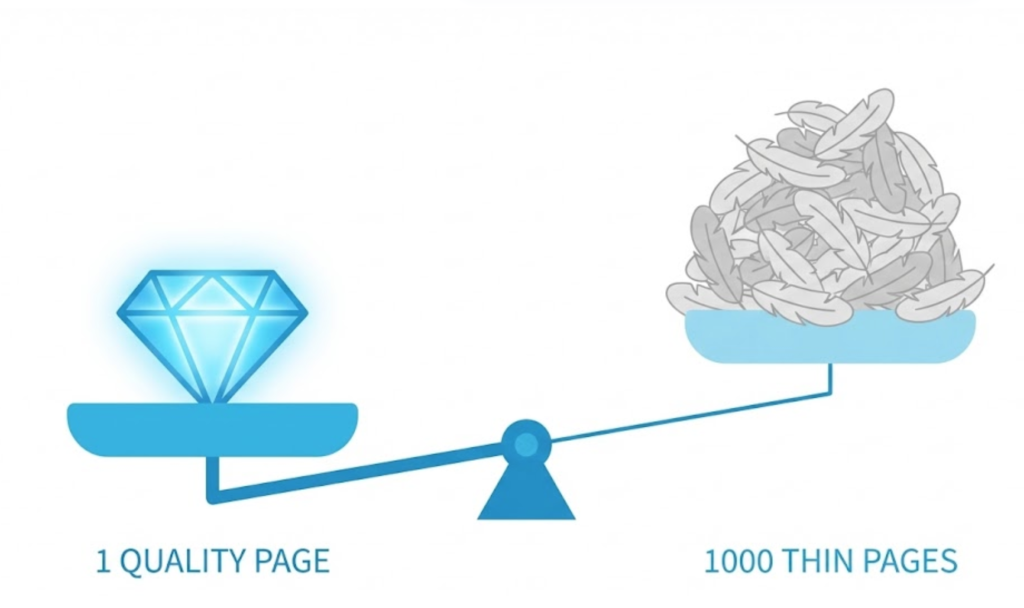
Why Thin Content Destroys SEO
You might think, “I’ll just leave the bad pages there. They aren’t hurting anyone.” But they are. They act like an anchor on your ship.
1. Site-Wide Quality Scoring
Google judges your site as a whole. If 80% of your pages are Thin Content, Google classifies you as a “Low Quality Site.” This drags down the rankings of your 20% “High Quality” pages (Pillar Pages). You are guilty by association.
2. Wasted Crawl Budget
As we discussed in our Crawl Budget guide, Googlebot has limited time. If it spends its budget crawling thousands of useless tag pages or empty categories, it won’t have time to find and index your new, valuable content.
3. Keyword Cannibalization
Often, thin pages end up competing with your good pages. A short, weak blog post about “SEO Tips” might prevent your “Ultimate Guide to SEO” from ranking #1. This is Cannibalization.
How to Identify “Zombie Pages”
We run a “Content Audit” using tools like Screaming Frog and Google Analytics. We look for “Zombie Pages”—pages that are technically alive but effectively dead.
The criteria for a Zombie Page:
- Less than 300 words of unique content.
- 0 organic traffic in the last 12 months.
- 0 backlinks pointing to it.
- High Bounce Rate (users land and immediately leave).
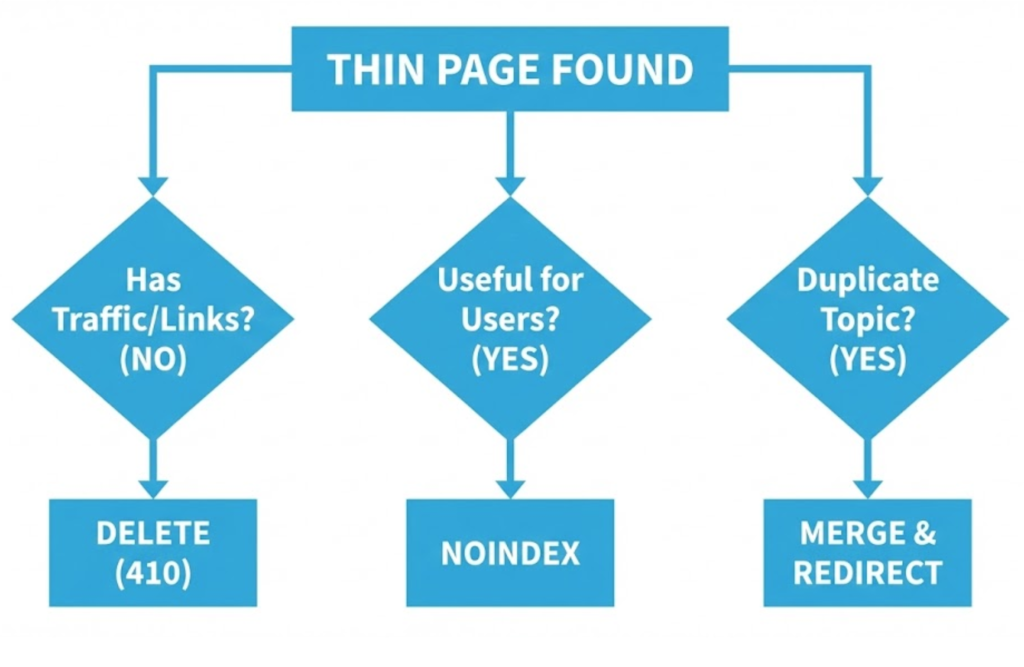
The Fix: Prune, Improve, or Merge (The Decision Tree)
Once we find the thin content, we use a Triage system to fix it.
| Action | Scenario |
| 1. PRUNE (Delete) | Page has no traffic, no links, and is irrelevant (e.g., “Christmas Party 2018”). Return a 410 (Gone) status. |
| 2. NOINDEX (Hide) | Page is useful for users but not Google (e.g., “Login” or “Thank You” page). Add a “noindex” tag. |
| 3. MERGE (Redirect) | You have 5 weak articles on the same topic. Combine them into one “Master Guide.” Redirect the 5 old URLs to the new one. |
| 4. IMPROVE (Expand) | Page targets a good keyword but is too short. Rewrite it. Add E-E-A-T, examples, and depth. |
Or, here’s a handy flowchart to use for reference:
The Takeaway
SEO is no longer a numbers game. It is a quality game.
Having 100 incredible pages is infinitely better than having 10,000 mediocre ones. Every page on your site should have a purpose. It should either answer a question, sell a product, or facilitate a user journey.
At Saint Digital, we don’t just build websites; we curate them. We regularly prune the dead weight to ensure your site stays lean, fast, and authoritative in Google’s eyes.
Is your site carrying too much dead weight? Let’s audit it.
Quality over Quantity
A bloated website is a sinking ship. If you have thousands of low-quality pages, you are hiding your best content from Google. We at Saint Digital perform ruthless Content Audits. We identify the thin content, prune the waste, and boost the authority of your entire domain.
Let’s clean up your site.
Learn more from our Glossary
© Saint Digital Ltd, 2020-26, all rights reserved.