
Keyword Density

What is Keyword Density? (And Why the “Perfect Ratio” is a Myth)
One of the most common questions we get from new clients during an SEO consultation is: “How many times should I mention the keyword on this page to make it rank?”
They are looking for a magic number. They want us to give them a secret formula, like “Exactly 2.5%.” They believe that if they hit this mathematical target, the gates of Google will open, and they will be ushered to the #1 spot.
Here is the hard, honest truth: That formula does not exist.
Welcome to the decoder ring. Keyword Density is the percentage of times a target keyword appears on a webpage compared to the total word count.
For years, this was the golden rule of SEO. Today, it is a trap. Obsessing over keyword density is the fastest way to write robotic, unreadable content that Google hates.
At Saint Digital, we don’t count keywords; we count value. We write for the human reader first, knowing that modern search engines are smart enough to understand context without being spoon-fed the same phrase 50 times.
Is your content triggering spam filters?
Obsessing over keyword density often leads to “over-optimization” penalties that tank your rankings. Learn how to audit your site for natural language and semantic relevance in our complete framework.
The Math: How Density is Calculated
Before we debunk it, let’s understand the math behind it. It is a simple equation:
(Number of times keyword appears / Total word count) x 100 = Density %
- If you write a 1,000-word article and use the phrase “red shoes” 10 times, your density is 1%.
- If you use it 50 times, your density is 5%.
In the “Wild West” of early 2000s SEO, marketers realized that search engines were essentially simple calculators. If they just increased that number to 5%, 10%, or even 20%, they could trick the machine into thinking their page was the most relevant result. This birthed the era of “Keyword Stuffing.”
The “Stuffing” Era (A Cautionary Tale)
You remember these websites. They were painful to visit. The text would read something like this:
“Looking for cheap holidays? We offer the best cheap holidays. Our cheap holidays to Spain are the best cheap holidays for families looking for cheap holidays in 2005.”
It was awful. It broke every rule of good writing. But for a while, it worked.
Then, Google fought back. They released the Panda and Hummingbird updates. These were game-changers. Google stopped matching “strings of characters” and started understanding topics.
Today, Google’s algorithm (powered by AI models like BERT) reads like a human. It understands nuance. If you repeat a word unnaturally, Google doesn’t reward you; it marks your site as Spam. It degrades your E-E-A-T (Trust) score and can even hit you with a Manual Action penalty.
The Modern Strategy: “Semantic Relevance” (TF-IDF)
So, if we don’t count keywords anymore, what do we do?
We focus on Semantic Relevance (technically known in data science as TF-IDF: Term Frequency-Inverse Document Frequency).
Think of it this way: Google knows that an article about “Apple” that mentions “iPhone,” “MacBook,” and “Tim Cook” is about the Tech Company. It knows that an article about “Apple” that mentions “Pie,” “Fruit,” “Orchard,” and “Cinnamon” is about the Food.
You don’t need to repeat the word “Apple” 50 times to prove your point. You need to use the vocabulary of the topic. This is the foundation of our SEO services.
The Saint Digital “Context” Strategy:
- Primary Keyword: We use the main term only where it matters (see “Power Positions” below).
- LSI Keywords (Synonyms): We use variations naturally. Instead of saying “Web Design” ten times, we say “Website Building,” “Digital Design,” “Online Presence,” and “UX Design.”
- Related Concepts: We include the supporting words that prove depth. If we are writing about “SEO,” we must mention “Rankings,” “Google,” “Traffic,” and “Backlinks.” If those words are missing, Google knows our content is thin.

The “Power Positions” (Where Placement Beats Frequency)
Here is the secret: Instead of worrying about how many times you use a keyword, worry about where you put it.
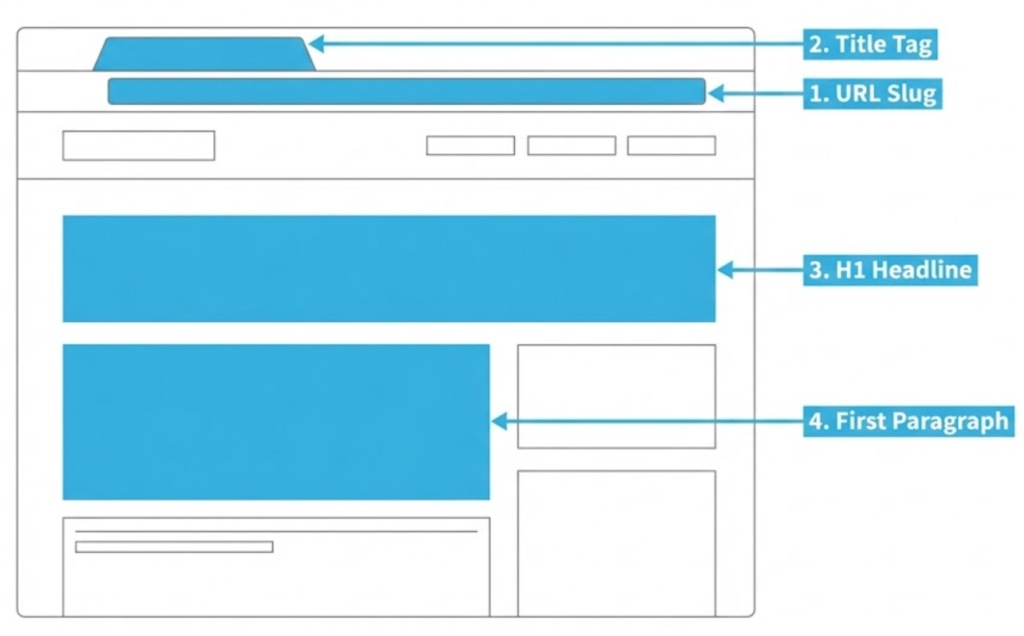
Search engines use a “Weighted” system. A keyword in your Headline is worth 10x more than a keyword buried in the footer. To rank perfectly without looking spammy, you simply need to hit the four Power Positions:
- The URL Slug: Keep it clean and exact. (e.g.,
/red-running-shoes). - The Title Tag: This is the blue link on Google. It is the strongest signal.
- The H1 Tag: The main headline on the page itself.
- The First 100 Words: The introduction. Tell Google (and the user) exactly what the page is about immediately.
Once you have hit those four spots, you can relax. You have done the heavy lifting. For the rest of the page, just write naturally.
The “Yoast Green Light” Trap
Many of our clients use WordPress plugins like Yoast SEO or RankMath. These tools have a “Keyword Density” checker that turns Red if your density is too low or too high.
Please, do not obsess over this light.
These tools are robots following simple math. They don’t understand context or tone.
- If you are writing a short, 50-word product description, a high density (4%) might be totally natural.
- If you are writing a 3,000-word emotional story, a very low density (0.5%) might be perfect.
Use the tool as a rough guide to ensure you haven’t forgotten the keyword entirely, but never rewrite a perfectly good sentence just to satisfy a plugin.
The “Read-Aloud” Test
If you are worried you have overdone it, there is one test that never fails: Read your content out loud.
The human ear is much better at spotting spam than the human eye. If you find yourself stumbling, feeling silly, or sounding like a broken record as you say the keyword for the fifth time in one paragraph—delete it.
If it sounds natural to speak, it will rank well on Google. Readability is the only metric that truly matters.
The Takeaway
Keyword Density is a relic of the past.
It comes from a time when search engines were dumb and needed to be hit over the head with a term to understand it. Today, Google is smart. It values depth, context, entities, and natural language.
At Saint Digital, we optimize for the user, not the calculator. We build Content Strategies that target topics, not just terms. We ensure your pages are rich, relevant, and readable—which is exactly what Google wants.
Are you writing for robots or humans? Let’s fix your copy.
Write for humans, not robots.
If your content sounds robotic, your customers won’t trust you. We at Saint Digital create high-performance content strategies that balance SEO precision with engaging, natural copywriting. We help you rank without sounding like a spammer.
Let’s write something real.
Learn more from our Glossary
© Saint Digital Ltd, 2020-26, all rights reserved.