
AI Overviews

What are AI Overviews? (And How to Survive Google’s Biggest Change)
For 25 years, Google search worked the same way. You typed a question. You got a list of 10 blue links. You clicked one to find the answer.
That era is ending.
Now, when you search for “How to plan a budget,” you don’t see a list of links first. You see a massive, colourful, AI-written summary that answers your question directly.
This is an AI Overview.
Welcome to the decoder ring. Formerly known as SGE (Search Generative Experience), AI Overviews are Google’s way of using Generative AI to synthesise information from across the web into a single, coherent answer at the top of the page.
At Saint Digital, we see this not as a threat, but as a new battlefield. The goal isn’t just to rank #1 anymore; the goal is to be the Source that the AI quotes.
Don’t get left behind by the algorithm.
AI Overviews are reshaping how users find information, often pushing traditional links further down the page. Learn how to future-proof your SEO strategy in our comprehensive guide.
The “Sandwich” Layout: How Search Has Changed
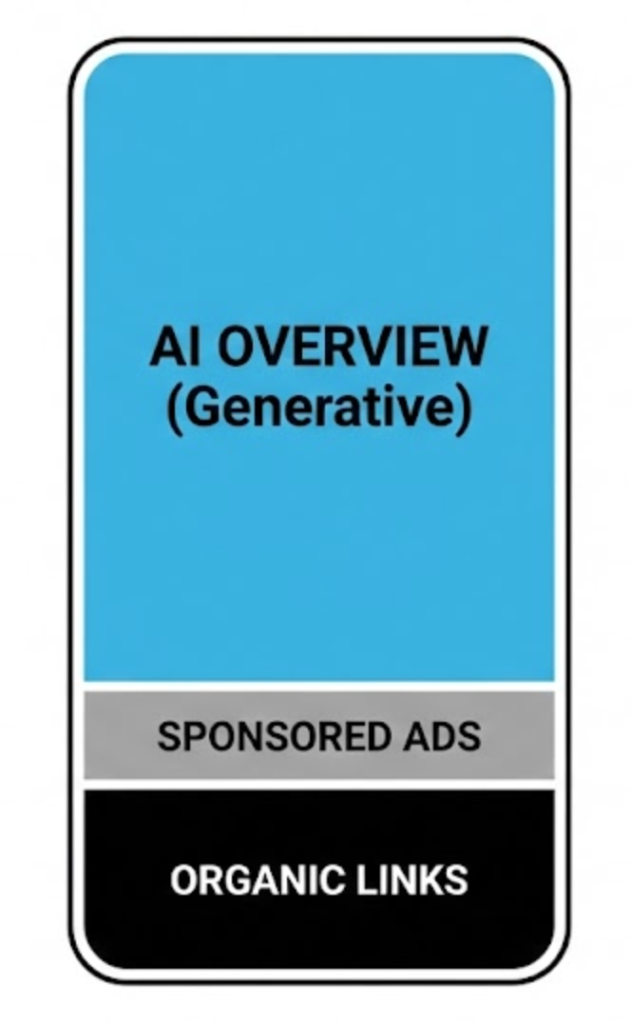
To understand the impact, look at the new layout of a search result page.
- Top Bun (The AI Overview): A large block of text generated by Gemini (Google’s AI). It takes up the entire “Above the Fold” screen on mobile.
- The Filling (Sponsored): Google Ads often appear above or below the AI block.
- Bottom Bun (Organic Results): The traditional “10 blue links” are pushed further down the page.
If your SEO strategy relies solely on “ranking #1 organic,” you might find yourself invisible. You need a strategy to break into the Top Bun.
Technical Insight: How RAG Works
AI Overviews are powered by a technology called RAG (Retrieval-Augmented Generation).
Unlike ChatGPT, which relies on old training data, Google’s AI performs a live search (Retrieval) to find the latest articles, and then uses its language model (Generation) to summarize them. This means you can influence the AI. If your content is the most relevant “retrieved” data, you become part of the answer.
How Does Google Decide What to Show?
AI Overviews include Citation Cards—clickable links to the websites they used as sources. Being cited is the new “Position Zero.” The AI looks for three things:
1. Corroboration (Consensus)
The AI wants to be accurate. If 10 reputable websites all say “The sky is blue,” the AI will agree. If your website is the only one saying “The sky is green,” the AI will ignore you. Your content needs to align with the consensus of trusted experts.
2. Information Gain (Originality)
The AI craves unique data. If you have a unique statistic or a fresh quote that adds value, the AI is more likely to cite you as a “specialist” source. See our guide on Information Gain.
3. Structure (Readability)
The AI is a robot. It loves Headings, bullet points, and clear definitions. If your answer is buried in a rambling essay, the AI will miss it.
How to Optimise for AI Overviews (AEO)
This new discipline is called AEO (Answer Engine Optimisation). Here is the Saint Digital playbook.
1. The “Fluency” Optimization
Write simply. The AI prefers content that is direct and factual. Use the “Question and Answer” format. Make your H2 the question, and the paragraph immediately following it the direct answer.
2. Be the “Primary Source”
AI Overviews love data. If you publish an original industry survey, the AI will often use your numbers to build its answer.
3. Survive the “Zero-Click” Shift
Accept that for simple queries (“Capital of France”), you will get zero clicks. The AI answers it perfectly.
The Strategy: Pivot your content to complex queries (“Best 3-day itinerary for Paris”). The AI cannot give a human experience. It cannot review a hotel with nuance. Shift your strategy towards “Opinions, Reviews, and Guides.”
Brand Visibility in the AI Era
Even if a user doesn’t click your link, appearing in the AI Overview is a massive branding win. It signals that Google considers you a market leader. We optimise for this by building your Knowledge Graph entity, ensuring Google knows exactly who you are.
The Takeaway
AI Overviews are not the death of SEO. They are the evolution of it.
The days of writing low-quality, keyword-stuffed fluff are over. The future belongs to the experts.
At Saint Digital, our SEO services don’t fear the AI. We feed it. We structure your content to ensure that when Google’s new brain looks for an answer, your website is the first one it finds.
Ready to future-proof your rankings? Let’s build an AEO strategy.
Don’t be replaced by a robot.
Google is changing fast. If your content is generic, the AI will swallow it. We at Saint Digital build future-proof content strategies. We help you create the kind of deep, expert, original content that AI engines can’t replicate—only cite.
Let’s adapt and win.
Learn more from our Glossary
© Saint Digital Ltd, 2020-26, all rights reserved.