
Offpage SEO

What is Off-Page SEO? (Why Your Content Isn’t Enough)
You have built a beautiful website. Your technical foundation is solid, your site loads in milliseconds, and your On-Page SEO is flawless with perfectly optimized keywords. You launch the site and wait for the traffic.
Nothing happens. You are stuck on Page 5 of Google.
Why? Because you have built a fantastic shop in the middle of a desert. Nobody knows you are there. Nobody is talking about you. You have zero Reputation.
Welcome to the decoder ring. Off-Page SEO refers to all actions taken outside of your own website to impact your rankings within search engine results pages (SERPs).
If On-Page SEO is “what you say about yourself,” Off-Page SEO is “what others say about you.” And in the eyes of Google, what the rest of the world says matters far more.
At Saint Digital, we view Off-Page SEO as digital PR. It’s not just about mechanically getting links; it’s about building the authority, trust, and popularity required to beat your competitors.
Build a reputation that ranks.
Your content is only half the battle. To win competitive keywords, you need authority. Learn the proven strategies for earning high-quality backlinks and building trust in our complete guide to Off-Page strategy.
The Core Concept: Google as a Democracy
To understand Off-Page SEO, you have to go back to the original idea that made Google famous (the PageRank algorithm).
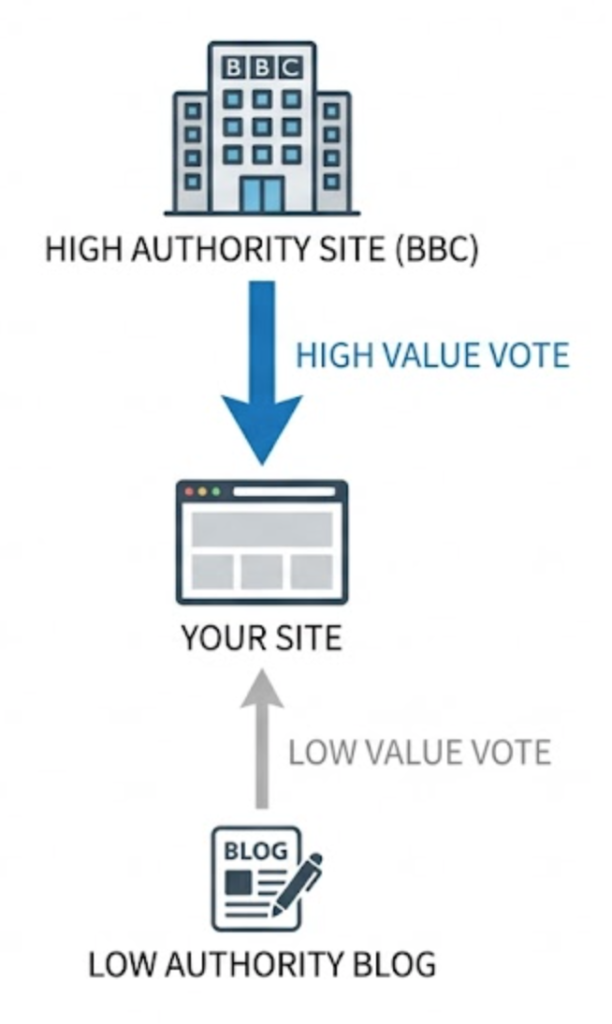
Google treats the web like a democracy. Every link from one website to another is a “vote.”
- If Website A links to Website B, it is effectively saying: “I trust this resource. It is valuable. My visitors should check it out.”
- The more votes (links) you have, the more popular and authoritative you appear to the search engine.
However, this isn’t a fair democracy. Not all votes are equal.
A vote from the BBC, The Guardian, or The University of Oxford counts for a million times more than a vote from a brand new, spammy blog. Off-Page SEO is the strategic process of earning these high-value votes to prove to Google that you are a market leader.
Pillar 1: Backlinks (Quality Over Quantity)
We have a full guide on Backlinks, but in the context of Off-Page SEO, they are the main event. However, the strategy has changed. In 2010, you needed *more* links than your competitor. In 2025, you need *better* links.
The Risk: Toxic Links & Penalties
Just as good links can boost you, bad links can bury you. If you buy 5,000 links from a “link farm” for $50, Google’s AI (SpamBrain) will detect it. These are called Toxic Links.
Acquiring too many of these can lead to an algorithmic devaluation (Google ignores the links) or a Manual Action (a human at Google delists your site). We use tools to audit backlink profiles and create a Disavow File—a document we submit to Google to tell them to ignore specific spammy links pointing to your site.
Pillar 2: Brand Signals (Entity SEO)
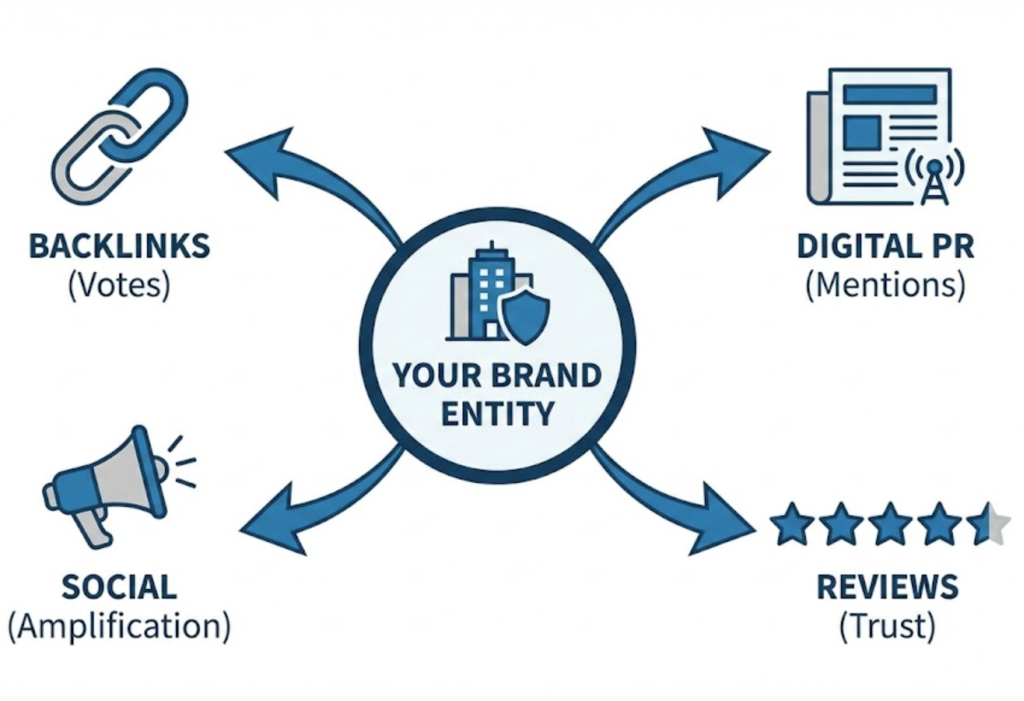
Modern SEO isn’t just about hyperlinks. Google is smart enough to read the web like a human. It looks for Brand Signals to build an understanding of your company as an “Entity” in its Knowledge Graph.
- Unlinked Mentions: If the New York Times mentions “Saint Digital” in an article but doesn’t actually link to our site, it still counts. Google reads the text, sees our brand name, and connects that mention to our reputation.
- Branded Search Volume: How many people go to Google and type “Saint Digital” specifically? If this number is growing, it tells Google you are a popular, real-world brand that people are actively seeking out.
Pillar 3: Digital PR and E-E-A-T
Off-Page SEO is the primary way you build E-E-A-T (Experience, Expertise, Authoritativeness, and Trust).
You can’t just claim to be an expert on your own “About Us” page. You need third-party validation. Digital PR is the process of getting that validation.
- Expertise: Publishing guest articles on industry-leading publications.
- Authority: Getting cited as a source by news outlets or journalists.
- Trust: Collecting positive reviews on independent platforms like Trustpilot and Google Maps.
The Social Media Misconception
Does posting on Facebook, LinkedIn, or X (Twitter) help your SEO?
Directly? No. Google has stated that social media links are not a direct ranking factor. A “Like” on Facebook does not pass the same authority as a backlink from a university.
Indirectly? Yes, absolutely. Social media is an Amplification Engine. If you write a great piece of content and share it on LinkedIn, and 10,000 people see it, there is a high chance that a blogger or journalist is among them. If that person then writes an article and links to you from their website, that is a backlink. Social media doesn’t improve rankings directly, but it gets your content in front of the people who *can* improve your rankings.
Technical Insight: Link Velocity
Google doesn’t just count how many links you have; it measures how fast you get them.
This is called Link Velocity. If a small local bakery suddenly gets 10,000 backlinks in 24 hours, Google triggers an alarm. Real businesses grow gradually. We carefully manage the pace of link acquisition to ensure your growth looks 100% natural and sustainable.
The Takeaway
You can control your On-Page SEO in a day. Off-Page SEO is a reputation game that you play forever.
It’s about building a brand that deserves to rank. It’s about creating content so good that people want to share it, building real relationships with influencers in your space, and serving customers so well they leave glowing reviews.
At Saint Digital, our SEO services don’t buy links. We earn them. We build the holistic strategies that turn your business into a digital authority that Google wants to put on Page 1.
Ready to build a reputation that ranks?
Build authority, not just links.
Ranking on Google is a popularity contest. If nobody is vouching for you, you won’t win. We at Saint Digital build sustainable, white-hat Off-Page strategies. We help you earn the high-quality links and brand recognition that drive long-term growth.
Let’s build your reputation.
Learn more from our Glossary
© Saint Digital Ltd, 2020-26, all rights reserved.