
Doorway Pages
What are Doorway Pages? (The “City Spam” Trap)
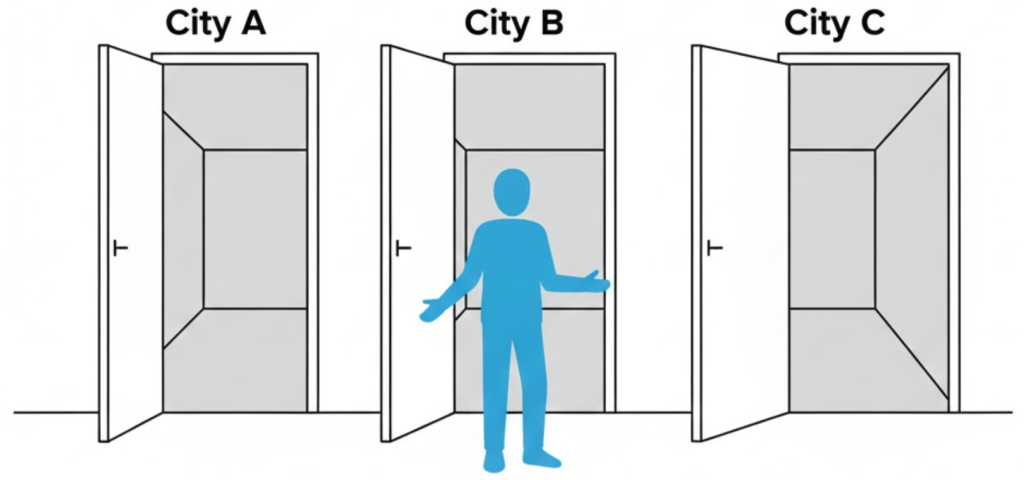
Imagine you are walking down a hotel corridor. You see 50 doors. One is labeled “Gym,” one is labeled “Pool,” one is labeled “Spa.”
You open the “Gym” door, and it leads into a large ballroom. You go back and open the “Pool” door, and it leads into the same ballroom. You would be annoyed. You were tricked. The doors weren’t real destinations; they were just different labels for the exact same room.
In SEO, these are Doorway Pages.
Welcome to the decoder ring. Doorway Pages are low-quality webpages created solely to rank for specific queries (like “Plumber Leeds,” “Plumber York”), but which funnel users to the same destination or offer identical content.
At Saint Digital, we see businesses build these thinking they are clever. But Google hates them. It is a violation of spam policies and the fastest way to get your site removed from the index.
Trying to rank in multiple cities?
You don’t need spammy pages to rank locally. You need a site structure that builds genuine authority without duplication. Our Technical SEO Guide explains how to structure your site for multi-location success.
The “Location Spam” Trap
The most common form of Doorway Page is the “City Clone.”
A business owner creates 50 pages and writes one paragraph: “We offer the best web design in [City Name].” They copy and paste it 50 times, just swapping the city name.
Why this fails:
- It is Thin Content: The page offers no unique value to a user in York that it doesn’t offer to a user in Leeds.
- It is Deceptive: You are clogging up search results with multiple pages that all lead to the same thing.
Programmatic SEO vs. Doorway Pages (The Confusion)
You might ask: “But TripAdvisor has a page for every city! Isn’t that a doorway page?”
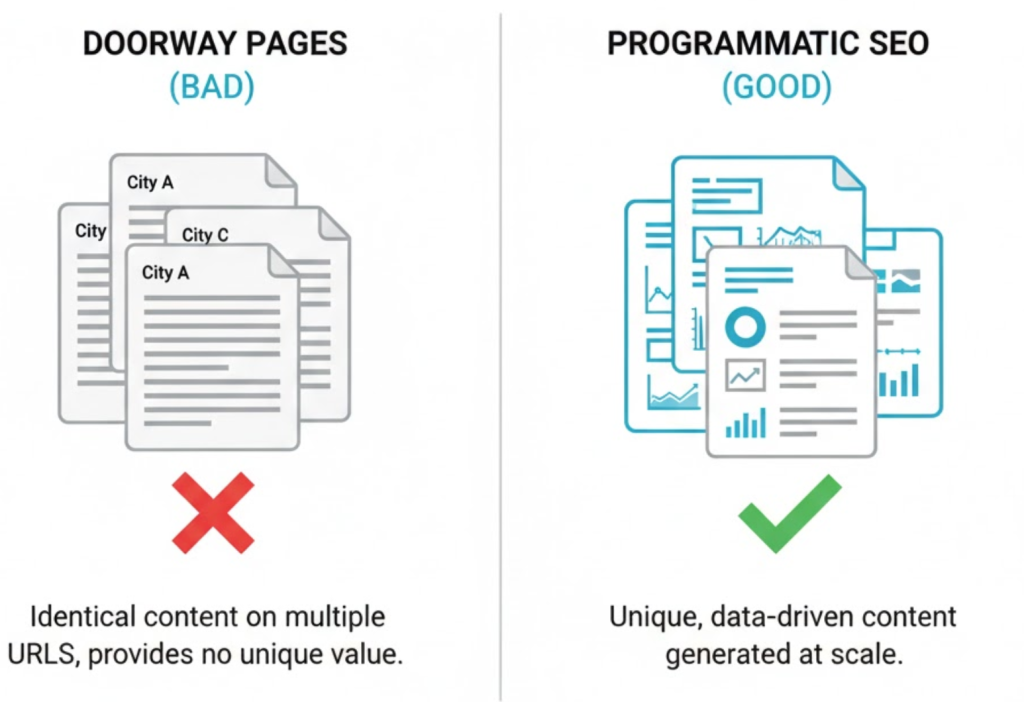
No. That is Programmatic SEO (pSEO). The difference is Data.
- Doorway Page: Same text, just a different header. Zero unique value.
- Programmatic Page: Unique data. TripAdvisor’s “Leeds” page has a list of actual Leeds hotels and reviews. It is genuinely useful.
Technical Insight: The “Substantially Similar” Rule
How does Google catch you?
Google’s “SpamBrain” AI compares the HTML code of your pages. It looks for “Substantial Similarity.” If Page A and Page B share 95% of the same code, layout, and text, with only a few distinct keywords swapped out, the algorithm flags them as duplicates/doorways. To pass the test, a page usually needs at least 50% unique, valuable content.
Other Types of Doorway Pages
It isn’t just about location.
1. The “Keyword Variation” Spam
Creating separate pages for “Cheap Running Shoes,” “Discount Running Shoes,” and “Low Price Running Shoes,” where all three pages look exactly the same.
2. The Affiliate Bridge
Creating a page that ranks for a product keyword but contains no original review—just a giant “Buy at Amazon” button. The page exists only to pass the user through to another site.
Doorway Page vs. Landing Page
This is where clients get confused. “Isn’t a landing page the same thing?”
No. The difference is User Intent.
- A Doorway Page exists only for the search engine. If you hid it from Google, you wouldn’t care if users saw it.
- A Landing Page exists for the user. It offers a specific solution to a specific problem.
How to Fix Doorway Pages (The Strategy)
If you have built these pages, you need to clean them up.
1. Consolidate (The Merger)
If you have 10 pages for variations of “Red Shoes,” merge them. Create one ultimate “Red Shoes” category page. Use 301 Redirects to point the old URLs to the new Master Page.
2. Localise (The Deep Dive)
Don’t create 50 empty pages. Pick your top 5 target locations and write unique content for each: “Our projects in Leeds,” “Meet our York team.” This adds Information Gain.
3. The “Areas We Cover” Page
For the smaller towns, just list them on a single “Areas We Cover” page. This tells Google where you work without creating spam.
The Takeaway
There are no shortcuts in SEO. If you are using a script to generate 1,000 pages in five minutes, you are building a house of cards.
At Saint Digital, our SEO services focus on creating fewer, stronger pages that build authority, rather than thousands of weak pages that dilute it.
Are you worried your site looks like spam? Let’s audit your structure.
Quality over Quantity.
Spamming Google with duplicate pages is a strategy that stopped working in 2012. Today, it’s a liability. We at Saint Digital clean up spammy site structures. We consolidate weak pages into powerful assets that rank safely and convert customers.
Let’s clean up your site.
Learn more from our Glossary
© Saint Digital Ltd, 2020-26, all rights reserved.