
Sentiment Analysis

In the digital world, “what” people say about you matters. But “how” they say it matters even more.
Sentiment Analysis (also known as Opinion Mining) is a sub-field of Natural Language Processing (NLP) used to identify the emotional tone behind a body of text. It allows search engines and AI models to determine whether a piece of content is positive, negative, or neutral.
For decades, computers could only read facts (data). They didn’t understand feelings. Today, algorithms like Google’s use Sentiment Analysis to judge the quality of your reviews, the trustworthiness of your content, and the overall reputation of your brand. In this guide, we explore how machines learned to read emotions and why it impacts your SEO performance.
1. How Sentiment Analysis Works
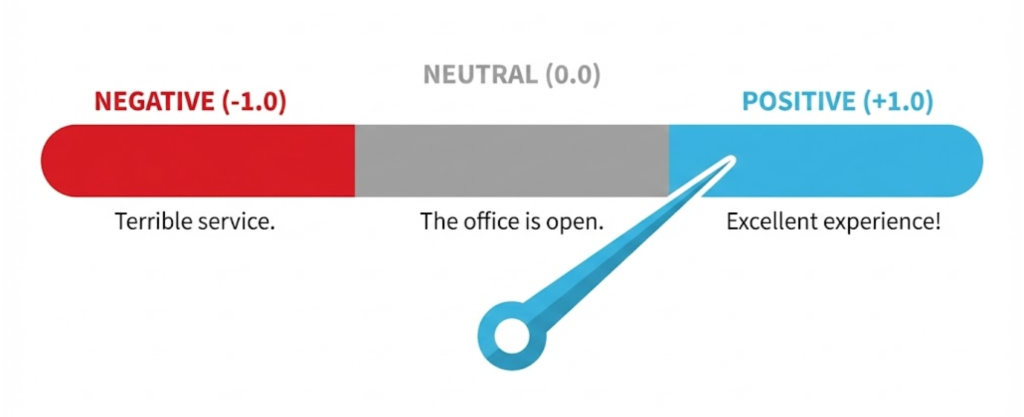
At its core, Sentiment Analysis is a classification problem. When an AI scans a sentence, it assigns a “Polarity Score” to the text. This score usually sits on a spectrum from -1.0 (Very Negative) to +1.0 (Very Positive).
The process involves three complex steps:
Step 1: Identifying the Subject (Aspect Extraction)
First, the AI must know what is being discussed. This links back to Entities.
Example: ” The battery life on this iPhone is terrible.”
The AI identifies “iPhone” as the Entity and “Battery Life” as the specific aspect.
Step 2: Isolating the Sentiment
It then looks for adjectives and modifiers (“Terrible”). Through machine learning, the model knows that “terrible” carries a heavy negative weight.
Step 3: Calculating the Score
The system combines the subject and the emotion to conclude:
Entity: iPhone | Aspect: Battery | Sentiment: Negative (-0.8).
2. The Three Buckets of Sentiment
Most search engines categorize content into three primary buckets. Understanding these helps you write content that aligns with Google’s quality guidelines.
- Positive Sentiment: Language that indicates satisfaction, happiness, or agreement. Google rewards this in Local SEO reviews because it signals a high-quality business.
- Negative Sentiment: Language indicating anger, frustration, or danger. While “bad reviews” hurt rank, Google also scans your blog content for negativity. If your health site uses fear-mongering language (“This vegetable will KILL you!”), Google’s algorithms may flag it as “Clickbait” or low-quality.
- Neutral Sentiment: Factual, objective language. This is the gold standard for informational content (Wikipedia style). For YMYL (Your Money or Your Life) topics, maintaining a neutral, professional tone is critical for building trust.
3. Sentiment Analysis in Search Rankings
Google has never explicitly stated “Sentiment is a ranking factor,” but the evidence in their patent filings and Algorithm updates suggests it plays a massive role in two specific areas:
1. Review Quality & Local Search
In the Google Maps pack, star ratings are just the surface. Google’s AI reads the text of the reviews.
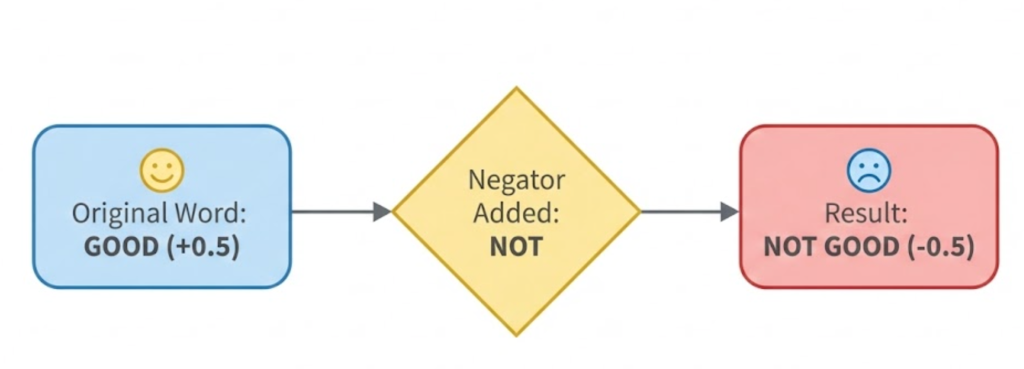
If you have 5 stars, but the text says, “Great food but the waiter was rude,” the Sentiment Analysis picks up the negative entity relationship (Waiter = Rude). Over time, if enough people mention “rude waiter,” Google may stop ranking you for queries like “Best service restaurant,” even if your star rating remains high.
2. Brand Authority & Unlinked Mentions
This is where Vector Search comes in. Google scans the web for mentions of your brand name, even if there is no hyperlink.
If your brand, “Saint Digital,” appears frequently near words like “Expert,” “Reliable,” and “Fast,” the sentiment score associated with your brand vector rises. This “Off-Page Sentiment” acts as a trust signal that can boost your rankings across the board.
4. The “Sarcasm” Problem
The biggest challenge for AI is nuance. Humans use sarcasm, irony, and slang, which can confuse strict algorithms.
Example: “Oh, great. Another flat tire. Just what I needed.”
- Old AI: Sees the words “Great” and “Needed.” Classifies this as Positive.
- Modern AI (BERT/MUM): Uses Contextual Analysis. It recognizes that “Flat Tire” is a negative event. It understands that “Great” used in the context of a negative event implies sarcasm. It correctly classifies this as Negative.
This ability to detect sarcasm is why Google’s BERT update was such a game-changer. It allowed the search engine to understand the intent behind the words, not just the dictionary definition.
5. How to Optimize for Sentiment
You cannot control what others say about you, but you can control your own content. Here is how to use sentiment strategy in your marketing:
1. Audit Your Content Tone
Run your landing pages through a text analyzer. Are you using overly aggressive, negative, or salesy language? Google prefers helpful, positive, and authoritative tones. Soften your language to align with E-E-A-T guidelines.
2. Respond to Reviews (The “Sentiment Reset”)
When you get a negative review, your response matters. By replying calmly, professionally, and using positive keywords (“We are happy to fix this,” “committed to quality”), you inject positive sentiment data back into the thread. This helps dilute the negativity in the eyes of the NLP model.
3. Target “Best” and “Top” Queries
Users often search for sentiment directly: “Best SEO agency,” “Top rated plumber.” These are sentiment-based queries. To rank for them, your site needs to objectively demonstrate why you are the best, using data and testimonials (positive sentiment signals) rather than just bragging.
Conclusion
Sentiment Analysis is the digital equivalent of “reading the room.” It allows Google to look past the keywords and understand the human emotion behind a webpage.
In an era where trust is the ultimate currency, ensuring your brand is associated with positive, authoritative sentiment is no longer optional—it is essential.
Is your brand reputation hurting your SEO?
If Google associates your business with negative sentiment, no amount of technical optimization will save you. At Saint Digital, we help businesses build authoritative, trust-based content strategies that send the right emotional signals to search engines.
Click here to contact us and let’s start building a positive reputation for your brand.
Does Google think your brand is toxic?
You might have great keywords, but if the AI detects negative sentiment around your brand name, your rankings will suffer. Don’t let bad data define your reputation.
Ready to change the narrative? Let’s have a chat.
Learn more from our Glossary
© Saint Digital Ltd, 2020-26, all rights reserved.