
JSON-LD

What is JSON-LD? (The “Secret Language” Google Loves)
If you look at the source code of a modern website, you might see a strange block of code wrapped in curly brackets { }. It looks terrifying, but it is one of the most powerful weapons in your SEO arsenal.
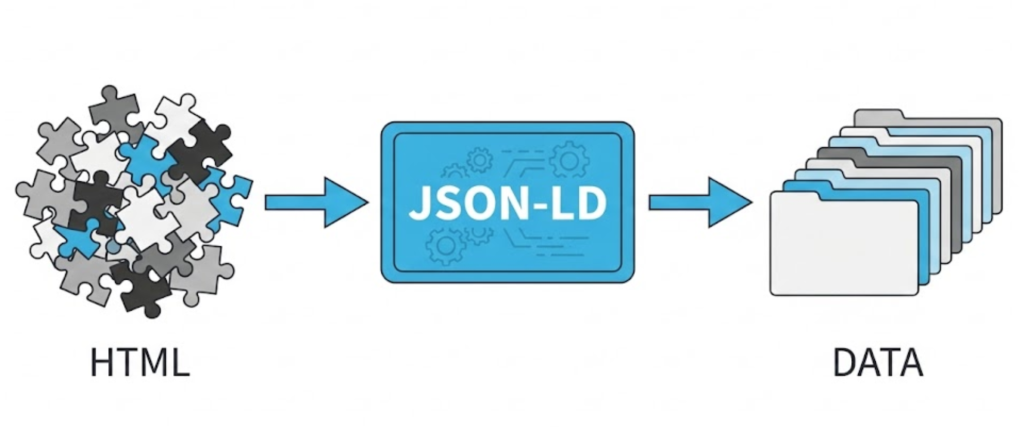
It is JSON-LD (JavaScript Object Notation for Linked Data). But you don’t need to be a developer to understand it. You just need to understand one concept: Translation.
Welcome to the decoder ring. JSON-LD turns your messy, human-readable website into structured data. It is the reason some websites get “Star Ratings” and “FAQ boxes” in Google, while others look boring.
At Saint Digital, we add this code to almost every site we build. It is the most direct way to speak to Google.
Speak Google’s language.
Structured data is the key to winning Rich Snippets and dominating the search results. Learn how to implement JSON-LD correctly in our complete technical guide.
The Analogy: The Librarian and the Index Card
Imagine your website is a book in a library. To figure out what it’s about, the librarian (Google) has to read every page and guess the context. “Is this page about ‘Jaguar’ the car, or ‘Jaguar’ the animal?” This takes time.
JSON-LD is like handing the librarian a printed index card.
On that card, you write:
- Type: Article
- Author: Saint Digital
- Topic: Web Design
Now, the librarian doesn’t guess. They know. JSON-LD is that index card.
JSON-LD vs. Schema Markup
This is the #1 point of confusion.
- Schema.org is the Dictionary. It’s the list of words we are allowed to use (like “Product,” “Review”).
- JSON-LD is the Grammar. It’s the format we use to write those words so the computer understands them.
It is a standalone block of JavaScript code. Unlike older formats (“Microdata”), it sits cleanly in the header and doesn’t break your visual design.
Why JSON-LD is Vital (The “Rich Snippet” Prize)
When you feed Google structured data, it rewards you with Rich Snippets.
1. Star Ratings (Review Schema)
Those five orange stars in search results increase CTR by up to 30%. They happen because you told Google: "aggregateRating": "5.0".
2. The “FAQ” Box
We use JSON-LD to wrap your Frequently Asked Questions, allowing Google to show a drop-down list of answers right in the search results, pushing competitors down the page.
3. Local Business Card
Essential for local SEO. It tells Google your exact address and coordinates, powering the Map Pack.
Technical Insight: The Knowledge Graph
JSON-LD does something even bigger than Rich Snippets: it connects you to the Knowledge Graph.
Google views the world as “Entities” (People, Places, Things). By using specific JSON-LD (like "sameAs": ["facebook.com/yourbrand", "linkedin.com/yourbrand"]), you prove to Google that your website, your physical office, and your social profiles are all the same Entity. This is how you earn a “Knowledge Panel” on the right side of the search results.
How to Check if You Have JSON-LD
You can’t see it on the page itself. Use Google’s free Rich Results Test tool. Paste your URL, and if you have valid JSON-LD, you will see a big green tick and a list of the data found.
The Takeaway
The web is moving from matching keywords to understanding the world. JSON-LD is how you explain your reality to the machine.
At Saint Digital, our SEO services hand-code JSON-LD into our sites. It’s the invisible layer of code that creates visible results.
Do you speak Google’s language?
Your website might look great to humans, but is it confusing the robots? We at Saint Digital speak fluent JSON-LD. We code structured data into every site to ensure Google understands your business, your products, and your value.
Let’s get you those stars in the search results.
Learn more from our Glossary
© Saint Digital Ltd, 2020-26, all rights reserved.