
Quality Content

What is Quality Content? (How Google Defines “Good” vs. “Bad”)
If you ask ten different people what “Quality Content” is, you will get ten different answers.
An English teacher will say it’s about perfect grammar. A designer will say it’s about beautiful layout. A salesperson will say it’s about persuasive copy that closes the deal.
But if you want to rank your website, only one definition matters: Google’s definition.
Welcome to the decoder ring. In the eyes of a search engine, “Quality” isn’t a subjective feeling. It is a specific set of measurable signals derived from billions of data points. It is the difference between a page that ranks #1 and a page that gets buried on page 50.
At Saint Digital, we don’t just write “nice blog posts.” We engineer high-performance content assets designed to satisfy Google’s strict quality algorithms. Here is what that actually means.
Does Google think your content is thin?
Low-quality content can drag down your entire site’s authority. Learn the signals Google looks for and how to satisfy the “Helpful Content” system in our complete strategy guide.
The Shift: From “Keywords” to “Helpfulness”
Ten years ago, “quality” meant “mentioning the keyword 20 times.” Today, that is considered spam.
Google’s algorithm has evolved massively. Its primary quality filter is now called the “Helpful Content System.”
This system asks a simple, brutal question: “Did this content leave the visitor feeling satisfied, or did they have to go back to the search results to find a better answer?”
If a user lands on your page, reads it, and leaves happy (stopping their search), that is a Quality Signal. If they land, get frustrated, and hit “back” (a high Bounce Rate), that is a Low-Quality Signal.
The 4 Pillars of Quality (The Google Checklist)
So, how do you ensure your user leaves happy? You must hit these four pillars, derived from Google’s “Search Quality Rater Guidelines.”
1. Comprehensiveness (Depth)
Thin content is the enemy. “Thin” doesn’t just mean short word count; it means shallow thinking. If a user asks “How to bake a cake,” and you give them 100 words saying “Mix flour and eggs then bake it,” that is Low Quality. It technically answers the question, but it’s useless.
High Quality content anticipates the user’s next questions. It covers the ingredients, the oven temperature, the mixing technique, and common mistakes. This is why Pillar Pages rank so well—they are comprehensive resources.
2. Originality (Insight)
The web is flooded with “copycat” content. If you look at the top 3 results for a keyword and simply rewrite them in your own words, you are adding zero value.
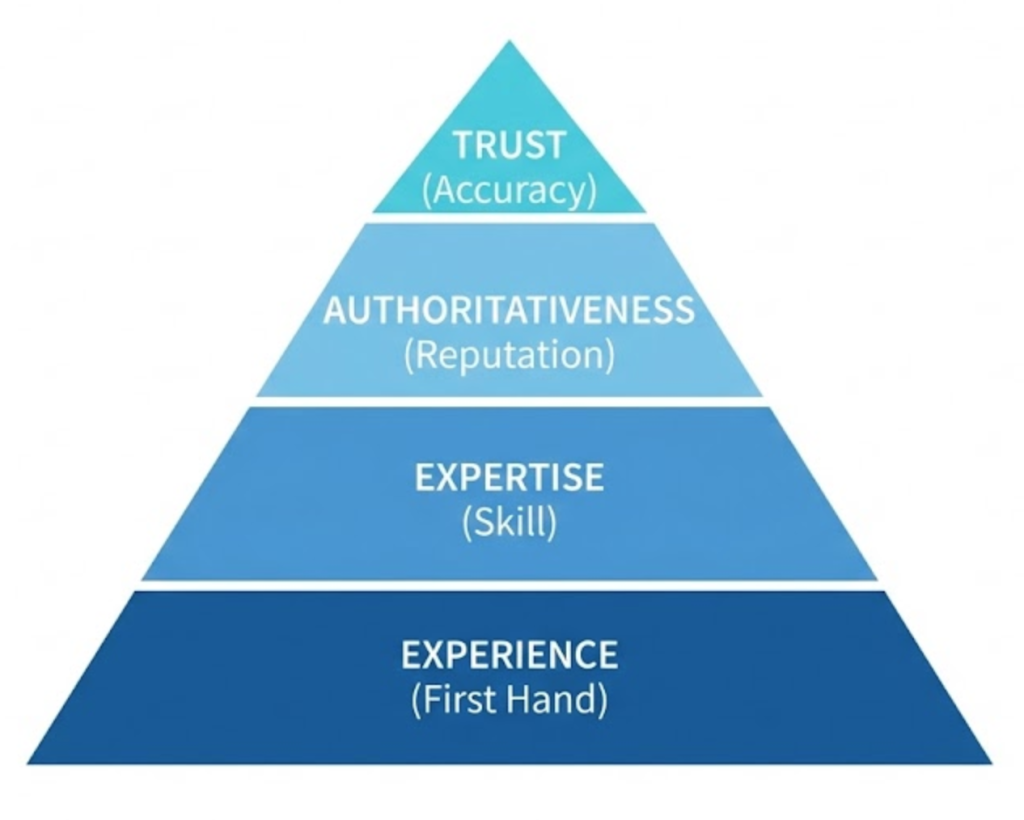
Google knows this. Quality content brings something new to the table: original data, a unique expert opinion, or first-hand experience (the “E” in E-E-A-T).
3. Structure & Readability (UX)
You can write the smartest article in the world, but if it looks like a “wall of text,” it is Low Quality.
Google knows that internet users scan. Quality content is designed for the screen. It uses clear Heading Tags (H1, H2, H3) to structure the argument, short paragraphs, bullet points, and images to let the eye breathe.
4. Accuracy & Trust (E-E-A-T)
This is critical for business websites. Is your content factually correct? Is it sourced? Is it written by an expert? If you are giving financial or medical advice, “Quality” means “Safety.” Linking out to authoritative sources (External Links) is a great way to signal that you have done your research.
The “Information Gain” Score
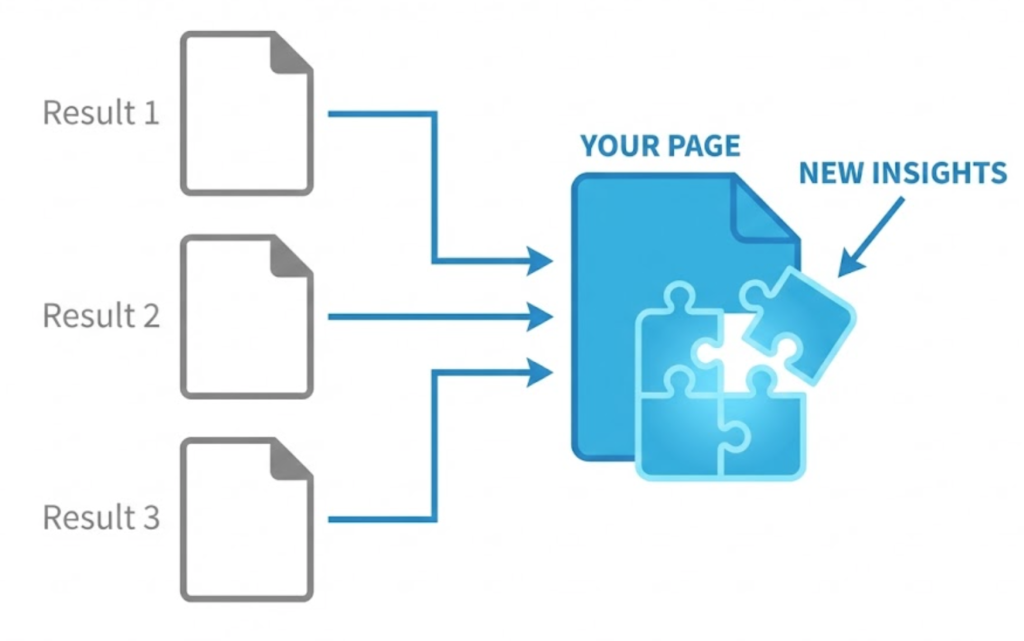
This is an advanced concept that separates the pros from the amateurs. Google holds a patent for a score called “Information Gain.”
It measures: “How much new information does this page provide compared to other pages the user has already seen?”
If a user reads 3 articles that all say the same thing, and then they read yours which adds a new statistic, a new perspective, or a new diagram, your Information Gain score goes up. To rank #1, you can’t just be as good as the competition; you have to be different.
The Danger of “AI Slop”
With the rise of ChatGPT, the web is being flooded with AI-generated text. Is this quality content?
Usually, no. Standard AI content is the definition of “Average.” It simply predicts the most likely next word based on existing content. It rarely adds new insight or experience.
Google has stated it doesn’t ban AI content, but it does ban “content created primarily for search engine rankings.” If you use AI to churn out 50 bland articles a day, you will likely be hit by the “Helpful Content Update” penalty. Quality requires a human editor.
The “Thin Content” Penalty
What happens if you ignore quality? Google has a specific algorithmic penalty for “Thin Content.” This often happens on:
- E-commerce sites: Product pages with just a photo and a price, but no description.
- Local Service pages: Creating 50 pages for “Plumber Leeds,” “Plumber Bradford,” etc., where text is identical except for the city name. (Doorway Pages).
If your site is full of thin content, Google might de-index those pages or lower the ranking of your entire site.
How We Measure “Quality” (It’s Not Just Feelings)
We don’t guess if content is good. We look at the data.
- Dwell Time: Are people staying on the page to read it?
- Scroll Depth: Are they reading to the bottom?
- Backlinks: Are other websites linking to it? (People only link to quality).
- Conversions: Is the content persuasive enough to make them click your CTA?
The Takeaway
Quality Content is an asset, not an expense.
Cheap, low-quality content is a liability. It costs money to produce, it clutters your site, and it can actively hurt your rankings. High-quality content works for you 24/7. It builds trust, attracts links, and convinces customers to buy.
At Saint Digital, our SEO services operate on a simple rule: if it’s not worth reading, it’s not worth writing. We produce content that deserves to rank #1.
Ready to upgrade your content strategy?
Stop writing. Start ranking.
The internet is full of noise. To win, you need to be the signal. We at Saint Digital don’t just fill pages with text. We craft high-performance content assets that satisfy Google, engage users, and drive revenue.
Let’s create content that counts.
Learn more from our Glossary
© Saint Digital Ltd, 2020-26, all rights reserved.