
Query

What is a Search Query? (The Difference Between “Targeting” and “Listening”)
In the world of digital marketing, we talk a lot about “Keywords.” We make lists of them. We track them. We obsess over them.
But here is the reality: Real people don’t type “keywords.” They type “queries.”
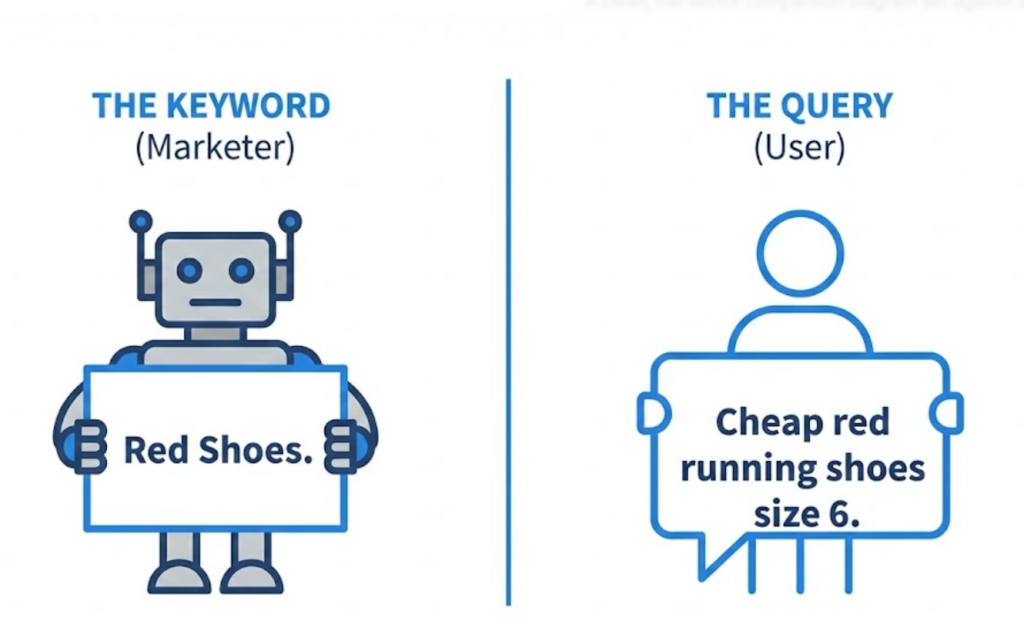
A Keyword is an abstraction—a neat, tidy little box that marketers use to categorise topics. A Search Query is the messy, specific, human string of words that a user actually types (or speaks) into the Google search bar.
Welcome to the decoder ring. Understanding the difference between a Keyword and a Query is the difference between marketing at people and listening to them.
At Saint Digital, we don’t just target keywords. We analyse queries. Why? Because the query tells us the truth. It reveals the user’s specific problem, their mood, their location, and exactly how close they are to buying.
Stop guessing what they want.
Keywords are just guesses. Queries are facts. Learn how to uncover the actual questions your customers are asking in our complete guide to research strategy.
The Golden Rule: Keyword vs. Query
These terms are often used interchangeably, but they are not the same. To master SEO, you must understand the distinction.
- The Keyword (The Marketer’s View): This is the idealised term you bid on or optimise for. It is broad and general.
Example: “Red Shoes.” - The Search Query (The User’s Reality): This is the actual text the user enters. It is specific and nuanced.
Example: “bright red running shoes for women size 6 cheap.”
You might target the keyword “Red Shoes,” but your user found you via that specific Long-Tail query. If you only look at the short keyword, you miss the nuance. You miss the fact that they wanted “running” shoes (not heels), they were looking for “women’s” sizes, and they were price-sensitive (“cheap”).
The 4 Types of Queries (The Intent Funnel)
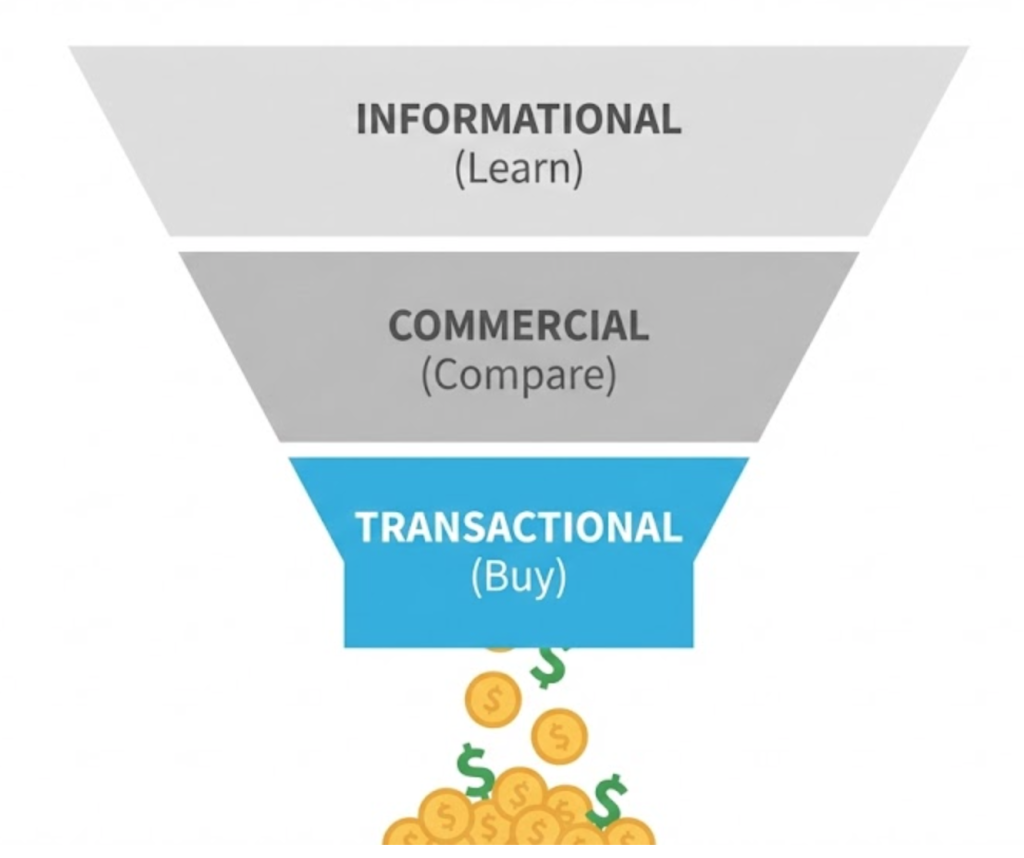
Just like Search Intent, queries fall into distinct buckets. Analyzing the language of the query tells you exactly what page to show them.
1. Navigational Queries (“Take me there”)
The user knows exactly where they want to go; they are just using Google as a taxi.
- Examples: “facebook,” “youtube login,” “saint digital contact.”
- The Insight: Brand dominance is key here. If someone types your brand name, you must own the top spot and the Knowledge Panel.
2. Informational Queries (“Teach me”)
The user has a question. These queries often start with “Who,” “What,” “Where,” “Why,” or “How.”
- Examples: “how to tie a tie,” “what is a meta description,” “london weather.”
- The Insight: These queries don’t usually lead to an immediate sale, but they are huge volume opportunities. This is where Quality Content wins. If you answer the query well, you build trust for later.
3. Commercial Investigation (“Convince me”)
The user knows they want a product, but they don’t know which one yet. They are comparing options.
- Examples: “best running shoes 2025,” “iphone vs samsung,” “top rated seo agencies leeds.”
- The Insight: You need comparison pages, “best of” lists, and case studies to win these queries.
4. Transactional Queries (“Sell me”)
The user is ready to act. These queries often contain “modifiers” that signal intent to buy.
- Examples: “buy iphone 15,” “web design agency leeds,” “discount code for asos,” “plumber near me.”
- The Insight: These are the money queries. Even if the search volume is low, the value is high. You must serve these users a Landing Page or product page, never a blog post.
The Rise of “Voice Queries” (Natural Language)
The way we search is changing. With Siri, Alexa, and Google Assistant, queries are becoming longer and more conversational.
- Typed Query: “weather london”
- Voice Query: “Will I need an umbrella in London today?”
This is Natural Language Processing (NLP) in action. To rank for voice queries, your content needs to answer specific questions directly, using natural, conversational language rather than robotic keyword stuffing.
The “Zero-Click” Query
Sometimes, a user types a query and never clicks anything.
This is called a Zero-Click Search. It happens because Google has become so good at answering queries directly on the results page using Featured Snippets, Knowledge Panels, or “People Also Ask” boxes.
Example Query: “What time is it in New York?”
Google shows the time. The user leaves. Zero clicks.
The Saint Digital Strategy: We analyse your queries to identify which ones are “Zero-Click” traps. We don’t waste resources fighting for queries that Google has already monopolised. Instead, we target complex, nuanced queries where the user needs to click through for a full explanation.
Mining Queries: The “Google Search Console” Goldmine
You can’t see exactly what people type into other websites, but you can see exactly what they type to find yours.
The tool for this is Google Search Console (GSC). Inside the “Performance” report, there is a list of “Queries.” This is actual user data, not estimates.
1. “Striking Distance” Queries
We look for queries where you rank on Page 2 (Positions 11-20). These are low-hanging fruit. With a little bit of optimisation (updating the content, adding the query to an H2 tag), we can often bump these onto Page 1.
2. “New Topic” Ideas
Sometimes, we see users finding your site via queries you never even thought of.
Example: You sell “Coffee,” but GSC shows people finding you for “Coffee gifts for dad.” Boom. That is a new blog post or product category you need to build immediately.
The Takeaway
Stop guessing what your customers want. Look at what they are actually typing.
A “Keyword” is a target. A “Query” is a conversation.
At Saint Digital, we are listeners. We use the data from search queries to understand the real language your customers use—not the industry jargon you think they use. We build content that answers their specific, messy, human questions.
Ready to join the conversation?
Listen to your customers
Your customers are telling you exactly what they want in the search bar. Are you listening? We at Saint Digital analyze search query data to find the hidden opportunities your competitors miss. We turn raw data into revenue-generating content.
Let’s find your next customer.
Learn more from our Glossary
© Saint Digital Ltd, 2020-26, all rights reserved.