
Schema Markup

What is Schema Markup? (The Secret to Getting “Stars” in Search Results)
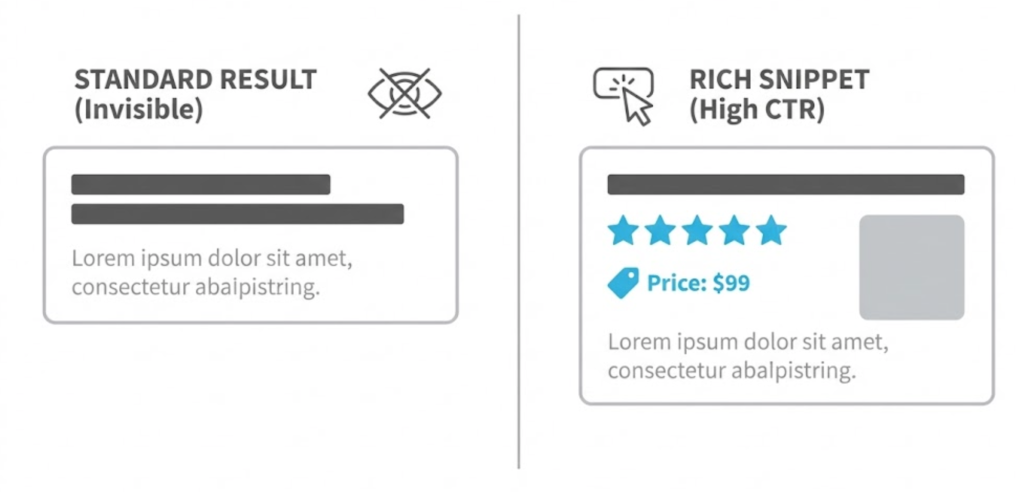
When you look at a Google search results page, most listings look identical. A blue headline. A short grey description. That’s it.
But then, your eye catches something else.
One result has five bright orange stars under it. Another has a thumbnail image of a tasty recipe. Another has the price of a product and an “In Stock” label listed right there.
Which one do you click? You click the one with the extra info.
That extra info is called a Rich Snippet. And the hidden technology that powers it is called Schema Markup.
Welcome to the decoder ring. Schema Markup is one of the most powerful “hidden” tools in Technical SEO. It doesn’t change how your website looks to humans, but it completely changes how your website looks to Google.
At Saint Digital, we implement Schema on every site we build. Why? Because in a crowded market, you don’t just need to rank #1; you need to dominate the visual space.
Do you want 5 stars in search results?
Schema is the only way to get Rich Snippets. Learn how to implement structured data to boost your Click-Through Rate (CTR) and authority in our complete technical guide.
What is Schema Markup, Technically?
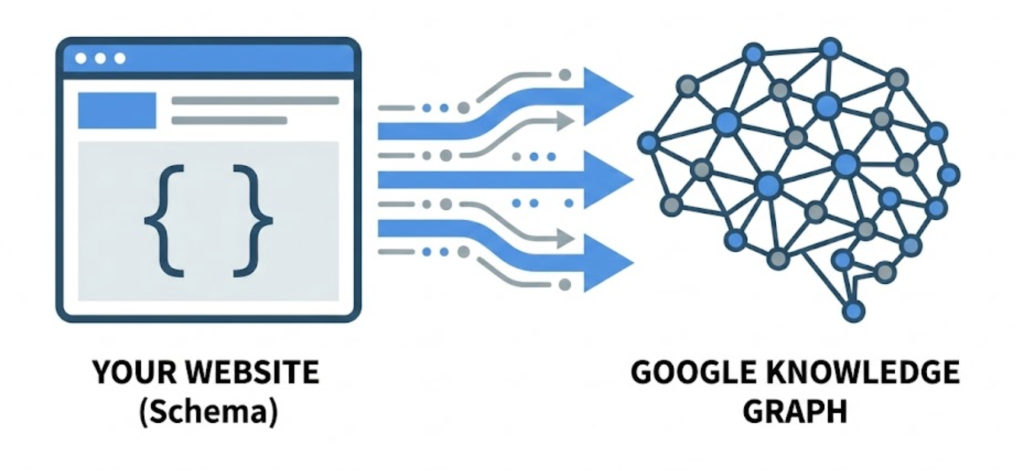
Schema Markup (found at Schema.org) is a shared vocabulary of code that search engines understand. Think of it as a dictionary for robots.
When Google crawls your website, it tries to “guess” what your content is. It sees a string of numbers like “0113 123 4567.” Is that a phone number? A product ID? The number of calories in a burger? Google has to guess.
Schema Markup removes the guesswork.
By wrapping that number in Schema code, you explicitly tell Google: “This is a telephone number for a LocalBusiness.”
When Google understands exactly what your content is, it can present it to users in “richer” ways. It turns raw data into visual features.
Schema vs. JSON-LD (Clearing the Confusion)
If you read our guide on JSON-LD, you might be confused. What’s the difference?
- Schema.org is the Dictionary. It defines the concepts (e.g., “Person,” “Event,” “Review”). It is the list of things you can say.
- JSON-LD is the Language. It is the specific coding format (JavaScript) used to write those concepts onto the page.
Think of Schema as the “What” and JSON-LD as the “How.” You use JSON-LD code to write Schema Markup.
Why Schema is the Key to High Click-Through Rates (CTR)
Schema is not a direct ranking factor. Adding Schema won’t magically bump you from position 10 to position 1.
However, it is a massive Traffic Factor.
Studies show that search results with Rich Snippets (like stars or FAQs) get a 30% higher Click-Through Rate (CTR) than standard results. Why?
- Visibility: They take up more physical pixels on the screen.
- Trust: Star ratings and “In Stock” labels build instant trust (proven E-E-A-T).
- Contrast: Colour (like orange stars) breaks the monotony of the blue-and-grey text list.
The “Big 4” Types of Schema for Business
There are hundreds of Schema types, but these are the four most valuable for business owners.
1. Organization & LocalBusiness Schema
This is essential for Local SEO. It tells Google your Name, Address, Phone Number (NAP), opening hours, and logo. This data feeds directly into the Knowledge Graph and powers Google Maps results.
2. Product Schema (E-Commerce)
If you sell things, this is non-negotiable. It tells Google:
- The Price
- The Currency
- Availability (“In Stock”)
- Review Rating (AggregateRating)
Google uses this to display product info directly in the search results and the “Google Shopping” tab.
3. Article & BlogPosting Schema
This helps your news and blog content appear in the “Top Stories” carousel at the top of Google. It tells Google the headline, the publish date, and the author (building author authority).
4. FAQPage Schema
This allows you to list Questions and Answers directly in the search result. It expands your listing vertically, pushing competitors further down the page. (Note: Google recently reduced the visibility of this, but it is still valuable for voice search).
Advanced Concept: Schema for AI & Voice Search
SEO is changing. With the rise of AI search engines (like Google’s Search Generative Experience) and Voice Assistants (Siri/Alexa), robots are doing more of the reading.
“Speakable” Schema is a new type that tells voice assistants exactly which part of a news article to read aloud.
These AI bots rely heavily on structured data to understand the world. If you want an AI to answer the question “Who is Saint Digital?” correctly, you need to feed it the facts using Schema. A site without Schema is a messy document. A site with Schema is a structured database of facts.
The “Manual Penalty” Warning
Schema is powerful, but you can’t lie.
You cannot use Schema to mark up content that isn’t visible to the user. This is called Spammy Structured Data.
Example: You can’t add “5-Star Rating” schema to a page that doesn’t actually have customer reviews visible on it. If Google catches you faking your markup to trick users, they will issue a Manual Action penalty and remove your Rich Snippets entirely.
How to Test Your Schema
You don’t have to guess if it’s working. Google provides a free tool called the Rich Results Test.
You simply paste your URL into the tool, and it will tell you:
- Which Schema types it found.
- If there are any critical errors (red).
- If you are eligible for Rich Snippets (green).
The Takeaway
Schema Markup is the difference between a “website” and a “verified entity.”
It is the layer of professional polish that tells Google you are serious about your data. It helps you dominate the visual space on the search results page and steal clicks from your competitors.
At Saint Digital, we don’t expect you to write code. We handle the technical implementation of Schema for you, ensuring your site is speaking Google’s language fluently.
Ready to stand out from the blue links?
Don’t blend in. Stand out.
If your search result looks just like everyone else’s, you are losing clicks. We at Saint Digital implement advanced Schema strategies to earn you the stars, badges, and rich snippets that grab attention and drive traffic.
Let’s make your listing shine.
Learn more from our Glossary
© Saint Digital Ltd, 2020-26, all rights reserved.