
Voice Search

What is Voice Search? (And Why You Need to Rank for “Spoken” Questions)
For twenty years, we have searched the web by typing. We sat at keyboards or tapped on glass, typing short, robotic phrases like “weather London” or “plumber prices.”
But the way we search is changing. We aren’t just typing anymore. We are talking.
“Hey Google, do I need a permit to build a shed?”
“Alexa, where is the nearest open coffee shop?”
This is Voice Search. Powered by smart speakers (Amazon Echo, Google Home) and mobile assistants (Siri, Google Assistant), it is the fastest-growing form of search in history.
Welcome to the decoder ring. Voice Search isn’t just a “cool feature.” It is a fundamental shift in user behaviour. It changes what people search for (longer questions) and how Google answers them (one single result).
At Saint Digital, we build sites for the “screenless” future. We optimize your content so that when a potential customer asks a question into the air, yours is the answer they hear.
Are you answering your customers’ questions?
Voice search relies on clear, direct answers. If your content is vague, you’re invisible. Learn how to structure your content for featured snippets and voice results in our complete guide.
The “One True Answer” Problem
Here is why Voice Search is terrifying for lazy marketers.
When you search on a desktop, you get 10 blue links. You have 10 chances to be seen. When you ask a Smart Speaker a question, it doesn’t read out 10 links. It reads out one answer.
If you aren’t that one answer, you are invisible. You effectively don’t exist.
So, where does that answer come from? In 80% of cases, Google Assistant reads the Featured Snippet (Position Zero) from the search results. This makes the battle for the Featured Snippet even more critical.
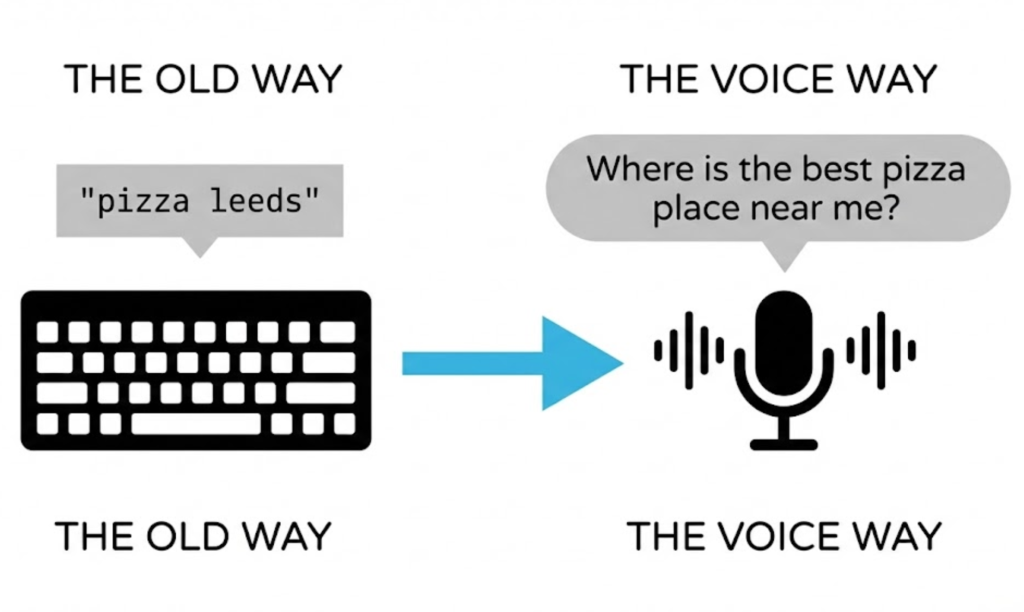
Keyword vs. Conversation (The Shift)
Voice searches are different from text searches. They are more human.
1. They Are Longer (Long-Tail)
We type in shorthand, but we speak in full sentences.
Typed: “best italian restaurant leeds”
Spoken: “Hey Siri, what’s the best Italian restaurant in Leeds that’s open right now?”
This means your strategy must shift to target Long-Tail Keywords. You need to target the full question, not just the short phrase.
2. They Are Question-Based
Voice searches are overwhelmingly questions. Who, What, Where, When, Why, and How.
The Fix: We build FAQ Pages and blog posts that use these exact questions as H2 headings. If you want to rank for the question, you have to write the question on your page.
3. They Have Strong Local Intent
People use voice search when they are on the go. “Where is the nearest…” “Is [Store Name] open?”
The Fix: This connects directly to your Local SEO strategy. Your Google Business Profile must be perfect.
How to Optimise for Voice (VSEO)
So, how do we get your website to “speak”? We use a specific optimization checklist.
1. Write for the Ear (Conversational Content)
Read your website content out loud. Does it sound like a robot? Or does it sound like a helpful human? Voice assistants prefer content that sounds natural. We write direct, concise answers.
Question (H2): “How much does a website cost?”
Answer (Paragraph): “The cost of a website depends on its complexity, but typically ranges from £1,000 to £10,000.”
This short, punchy paragraph is easy for Siri to read.
2. Use Schema Markup (Speak Robot)
We have to help the robots understand the context. By using Schema Markup (specifically “Speakable” schema or “FAQ” schema), we can explicitly tell Google: “Here is a question, and here is the answer suitable for audio playback.”
3. Mobile Speed is Non-Negotiable
Most voice searches happen on mobile devices. If your page takes 5 seconds to load, the voice assistant will timeout and move to the next result. Passing Core Web Vitals is essential.
Advanced Tip: Formatting for Featured Snippets
To win the voice result, you must win the snippet. The format matters:
- For “How to” questions: Use numbered lists (
<ol>). Google loves reading steps. - For “What is” questions: Use a concise definition paragraph (40-60 words).
- For “Comparison” questions: Use a table.
The “Near Me” Revolution
The phrase “Near Me” has exploded in popularity. “Plumber near me,” “Pizza near me.”
You cannot optimize a page for the keyword “near me” because “me” moves. To win these voice searches, you must prove to Google exactly where you are via your Google Business Profile and consistent location data.
The Takeaway
Voice Search isn’t a fad. It is the natural evolution of how humans interact with computers.
It demands that your website be faster, your content be clearer, and your technical foundation be stronger. It forces you to stop writing for “keywords” and start answering real human questions.
At Saint Digital, our SEO services don’t just build visual websites; we build conversational ones. We structure your data and content so that whether your customer is typing on a laptop or talking to their watch, you are the answer they find.
Ready to be heard?
Be the answer, not just a result.
In the world of Voice Search, there is no “Page 2.” You are either the answer, or you are silent. We at Saint Digital optimize your content for the conversational age. We help you capture the Featured Snippets that power Siri, Alexa, and Google Assistant.
Let’s get people talking about you.
Learn more from our Glossary
© Saint Digital Ltd, 2020-26, all rights reserved.