
Your Money Or Your Life (YMYL)

What is YMYL? (Why Google Treats Your Website Like a Medical Journal)
If you write a blog post about “My favourite cat videos,” and you get a fact wrong, nobody gets hurt.
But if you write a blog post about “How to cure a heart attack at home,” or “How to invest your pension,” and you get a fact wrong, the consequences are catastrophic.
Google knows this. And because of it, Google treats these two types of content completely differently.
Welcome to the decoder ring. YMYL stands for “Your Money or Your Life.”
It is a specific classification used in Google’s Search Quality Evaluator Guidelines. It refers to any webpage or topic that could potentially impact a person’s future happiness, health, financial stability, or safety.
At Saint Digital, we treat YMYL pages with extreme caution. If your business falls into this category, “good content” isn’t enough. You need expert content. The standards are higher, the scrutiny is tighter, and the need for trust is absolute.
Is your business considered “High Risk” by Google?
If you operate in health, finance, or law, you are held to a higher standard. Learn how to build the authority Google demands in our comprehensive guide to E-E-A-T and SEO.
The YMYL “High Stakes” Algorithm
To understand YMYL, you have to understand Google’s nightmare scenario: A user searches for medical advice, finds a fake article on Google, follows the advice, and gets sick. Google wants to avoid this at all costs.
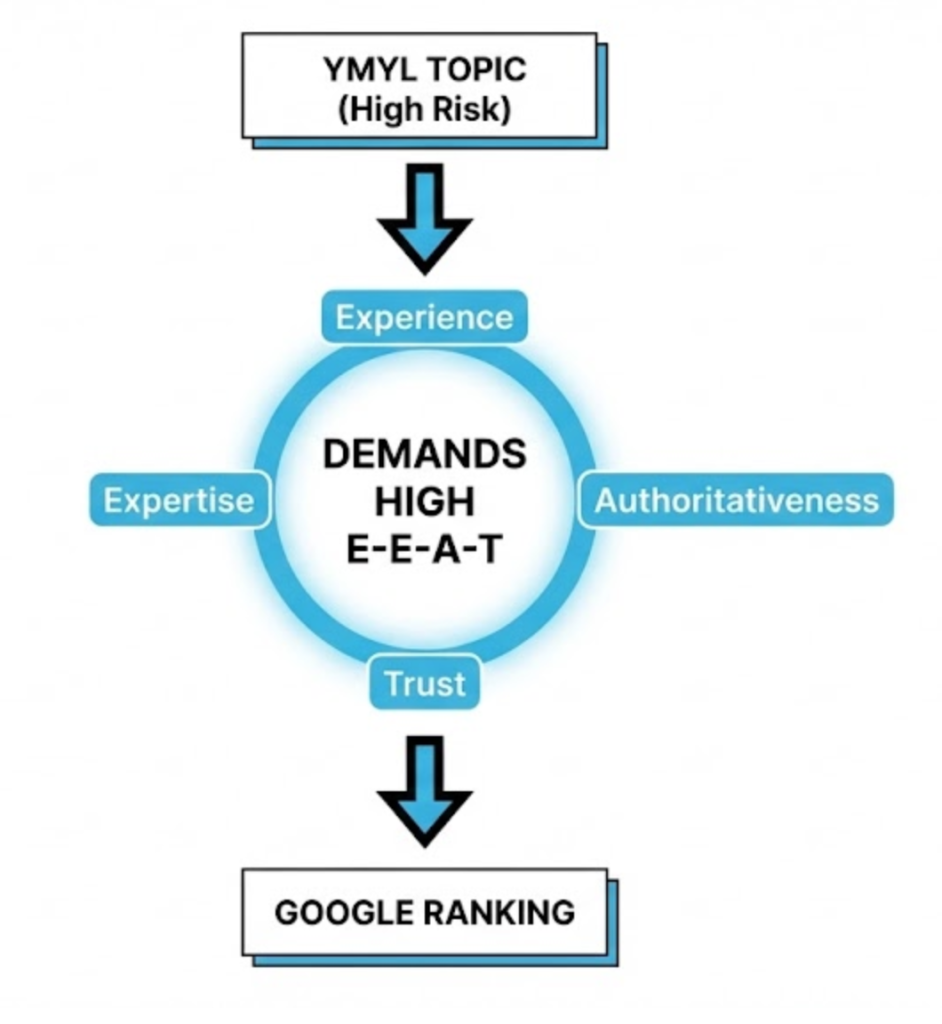
Therefore, for YMYL topics, Google’s algorithm dials up the importance of E-E-A-T (Experience, Expertise, Authoritativeness, and Trust) to the maximum level. If you cannot prove you are a qualified expert, Google will not rank you.
Does Your Site Count as YMYL? (The Checklist)
Many business owners think this only applies to doctors and banks. It doesn’t. The definition is broader than you think.
- 1. Health & Safety: Advice on medical issues, drugs, hospitals. If you sell vitamins, you are YMYL.
- 2. Financial Security: Advice on taxes, investments, loans, insurance. If you take credit card payments, your checkout page is YMYL.
- 3. Legal & Civic Info: Information on voting, government agencies, divorce, wills. Law firms are YMYL.
- 4. “Other” High Stakes Topics: High-value e-commerce (e.g., selling cars) is often treated as YMYL.
How to Rank a YMYL Website (The Strategy)
If you are in a YMYL niche, you cannot “fake it ’til you make it.” You have to prove your worth. Here is the strategy we use.
1. The “Who Wrote This?” Rule
Anonymous content is a death sentence for YMYL sites. Every article must have a named, qualified author. We create detailed Author Bio pages that link to the author’s credentials and use Schema Markup to feed this data to Google.
2. Cite Your Sources
Just like a university paper, you must back up your claims. Linking to authoritative sources (academic journals, major news outlets) via External Links builds authority. It shows Google you have done the research.
3. Keep it Fresh (QDF)
Old advice is dangerous advice. YMYL content requires regular auditing. We display the “Last Updated” date prominently so users (and Google) know the info is current.
Transparency Signals: About Page & Contact Info
Before Google trusts your content, it must trust your business. Who are you? Where are you located?
A generic “About Us” page won’t cut it. For YMYL sites, we ensure you have:
- A physical business address listed in the footer.
- A working phone number and email address.
- A detailed “About” page showing the team, their faces, and their qualifications.
If you look like a faceless shell company, Google will assume you are one.
The “Review” Trap (E-Commerce YMYL)
If a user review on your site makes a medical claim (e.g., “This tea cured my cancer!”), Google holds you responsible for that claim.
We advise YMYL clients to moderate reviews carefully. You cannot allow unverified medical or financial claims to appear on your pages, even in user-generated content.
The Takeaway
YMYL isn’t a penalty; it is a standard of excellence. It forces you to be a better, more transparent business.
If you operate in a high-stakes industry, you cannot afford “cheap” SEO. You need a strategy that understands the nuances of trust.
At Saint Digital, our SEO services build digital fortresses of authority. We ensure every signal tells Google: “You can trust us with your users.”
Is your site trustworthy enough to rank?
Trust: your most valuable ranking factor.
In YMYL industries, you don’t just need keywords; you need credentials. We at Saint Digital specialize in high-stakes SEO. We build the author profiles, schema markup, and trust signals that prove to Google you are the expert.
Let’s build your authority.
Learn more from our Glossary
© Saint Digital Ltd, 2020-26, all rights reserved.