
Meta Keywords
What are Meta Keywords? (The “Zombie Tag” of SEO)
If you learned digital marketing before 2009, you probably remember the “Meta Keywords” tag.
It was the magic field in your website’s code where you could simply list every word you wanted to rank for: “plumber, best plumber, cheap plumber, free plumbing.” It was easy. It was fast. And for a brief moment in the 90s, it actually worked.
Today, clients still ask us: “Where do I put my meta keywords in WordPress?”
The answer is: Nowhere.
Welcome to the decoder ring. Meta Keywords are a specific type of meta tag that appeared in the HTML code of a Web page to tell search engines the topic of the page. But here is the twist: Google has officially ignored this tag since 2009.
At Saint Digital, we don’t use them. In fact, we actively delete them from client sites during audits. Why? Because in 2025, using Meta Keywords isn’t just useless—it can actually be a strategic risk.
Are you using outdated tactics?
SEO has changed. If you are still focusing on meta keywords, you are missing the signals that actually matter. Get up to speed with our modern, data-driven framework.
The History: Why Did Google Kill the Tag?
In the late 90s (the era of AltaVista and Yahoo), search engines were primitive. They couldn’t “read” a page like a human. They relied on the “Honour System.” They trusted the webmaster to honestly list the keywords the page was about.
But marketers aren’t always honourable.
People started abusing the system. A local pizza shop would add “Britney Spears,” “Free MP3s,” and “Casino” to their keywords just to steal traffic. The tag became 100% spam. It was no longer a reliable signal of what a page was actually about.
So, Google stopped looking at it. They switched to analyzing the actual content on the page (what the user sees) and the links pointing to it. The “Magic Field” died overnight.
Does ANY Search Engine Use Them?
This is where it gets nuanced. Is it dead everywhere?
- Google: Zero impact. Google has confirmed repeatedly that they ignore it completely.
- Bing: In 2014, Bing hinted that they use it as a Spam Signal. This means if you stuff the tag with irrelevant junk, it doesn’t help you rank, but it might trigger a penalty. It’s a negative ranking factor, not a positive one.
- Yandex (Russia): Still uses it slightly, but it carries very low weight compared to content.
- Baidu (China): This is the only major engine where Meta Keywords still matter. If you are targeting the Chinese market, you should use them.
Unless you are specifically targeting China, the Meta Keywords tag is dead technology.
Why Using Them Can Actually Hurt You
You might think, “Well, it can’t hurt to add them, just in case.” Actually, it can.
1. It Reveals Your Strategy to Competitors
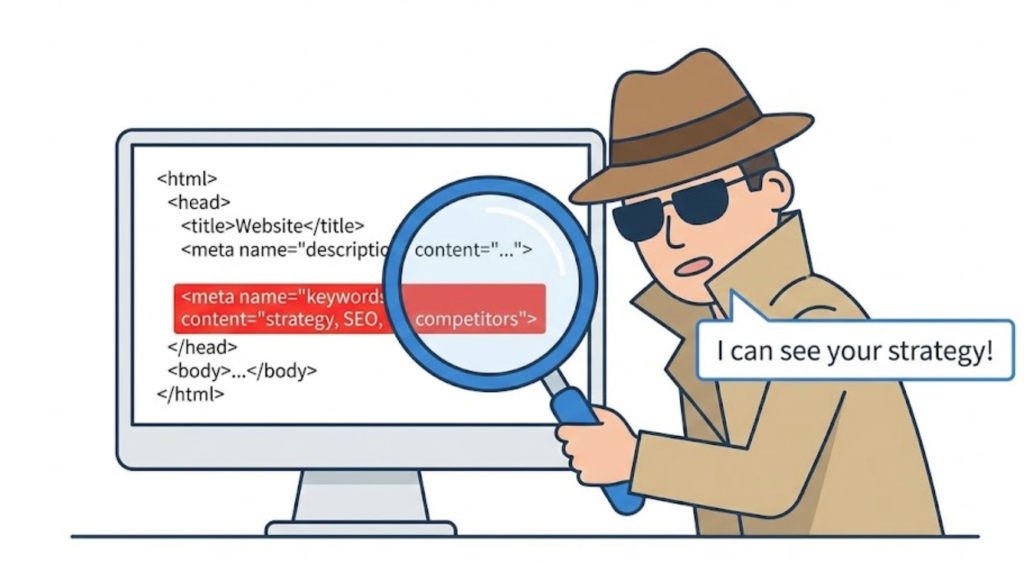
The Meta Keywords tag is visible in your source code. Anyone can right-click your page, select “View Source,” and see your list.
If you list your top 10 target keywords there, you are handing your entire Keyword Strategy to your competitors on a silver platter. They can see exactly what terms you are trying to win, and they can build content to beat you. Don’t show your hand in poker.
2. It Wastes Time
SEO takes time. Spending 10 minutes researching and typing tags that Google ignores is 10 minutes you didn’t spend improving your Title Tag or writing a better Meta Description—two tags that actually matter for rankings and clicks.
[Image of competitor spying diagram]
The One Exception: Internal Site Search
There is one specific scenario where we occasionally use Meta Keywords: Internal Search Engines.
If you have a large e-commerce site with its own search bar (powered by tools like Solr or Algolia), sometimes that internal search engine uses the meta keywords tag to help users find products.
Example: You sell a “Jumper.” You might add the meta keyword “Sweater” so that users searching for “Sweater” on your site still find the Jumper. But this is for your search bar, not Google’s.
What Replaced Meta Keywords?
The tag is dead, but the concept isn’t. You still need to tell Google what your page is about. You just have to do it differently.
1. Semantic Content (LSI)
Google now uses AI to understand “Topics.” Instead of hiding a list of words, you must write a comprehensive article that uses those words naturally. See our guide on LSI Keywords.
2. Schema Markup
This is the modern version of “meta data.” Use JSON-LD Schema to explicitly tell Google: “This is a Product. The price is £50. It is in stock.” This is structured data that Google actually trusts and rewards.
The Common Confusion: Keywords vs. Description
Clients often mix these up.
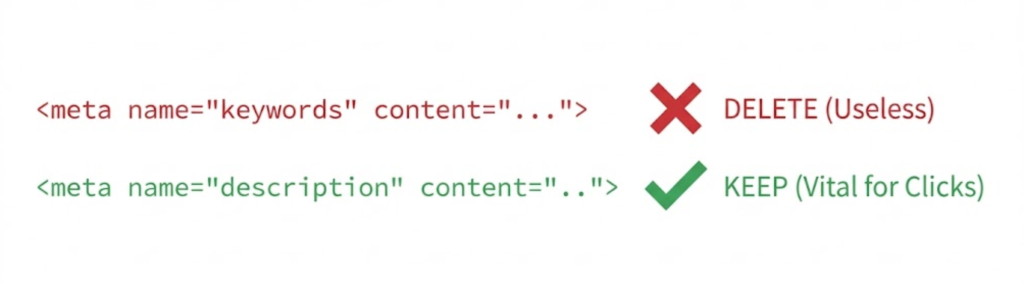
- Meta Keywords: A hidden list of words. (Useless)
- Meta Description: A hidden paragraph of text. (Vital)
The Meta Description shows up in the search results as your ad copy. It drives clicks. You absolutely should fill this out. Just don’t touch the Keywords field.
The Takeaway
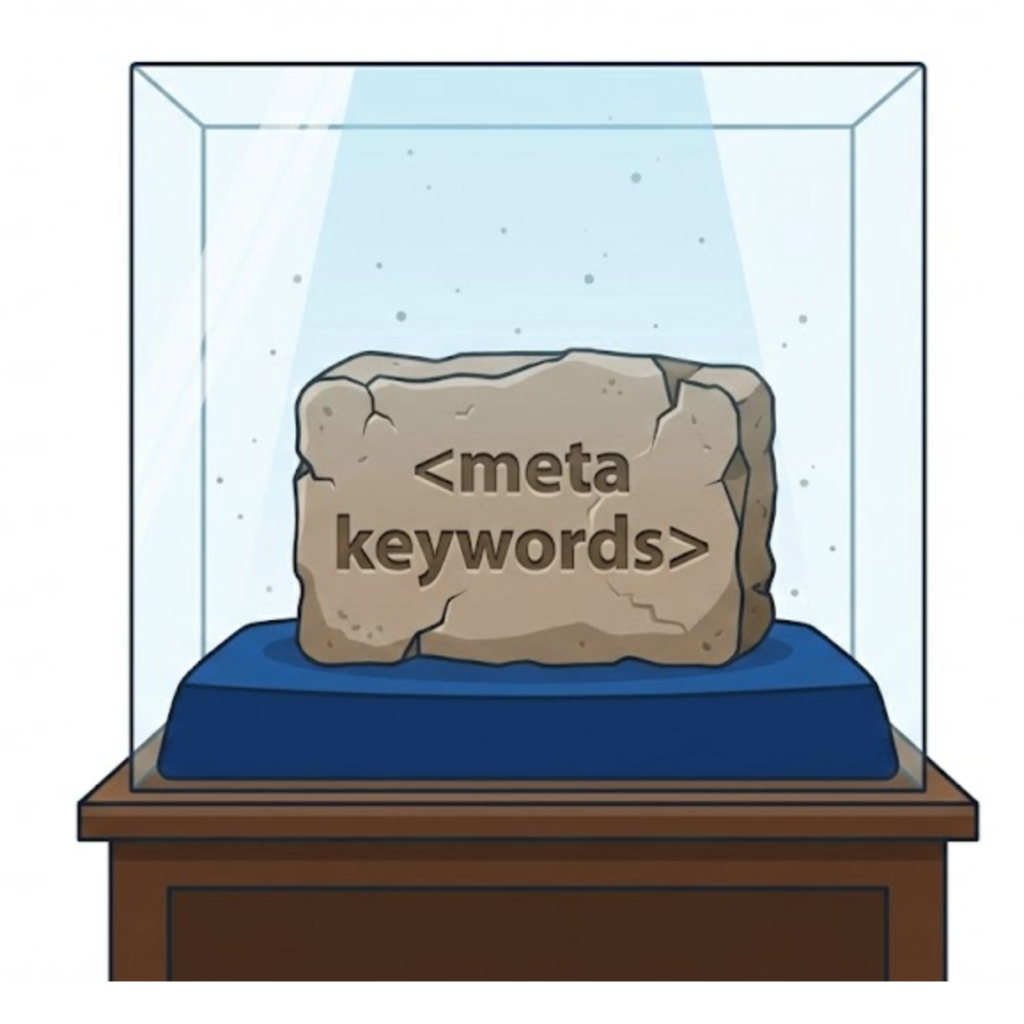
Meta Keywords are a fossil. They belong in a museum alongside dial-up internet and Flash player.
Using them signals that your SEO strategy hasn’t been updated in 15 years.
At Saint Digital, our SEO services focus on the signals that work today. We optimize your visible content, your technical structure, and your user experience. We don’t rely on hidden tricks; we rely on quality.
Are you wasting time on outdated tactics? Let’s modernise your strategy.
Stop living in 2009.
SEO strategies that worked a decade ago can hurt you today. We at Saint Digital use cutting-edge, 2025-ready strategies. We ignore the myths and focus on the technical and content signals that actually drive revenue.
Let’s future-proof your site.
Learn more from our Glossary
© Saint Digital Ltd, 2020-26, all rights reserved.