
Navboost
What is Navboost? (The Secret Algorithm That Watches Your Clicks)
For years, Google denied it.
They explicitly stated in interviews and webmaster hangouts that they did not use user behaviour data (like click-through rates, dwell time, or pogo-sticking) to rank websites. They claimed rankings were based purely on on-page signals (Keywords) and off-page signals (Backlinks).
Then, in 2024, the massive “Google API Leak” confirmed what experienced SEO experts had suspected for a decade: They were watching everything.
The system they use is called Navboost.
Welcome to the decoder ring. Navboost is one of Google’s most powerful, yet least understood, ranking signals. It is a machine learning system that tracks exactly how users interact with search results to determine if a website is actually helpful, regardless of what the keywords say.
At Saint Digital, we build websites with Navboost in mind. We know that in the modern era, you can’t just “trick” Google’s robot; you have to satisfy the human user. If the human is happy, Navboost boosts your ranking.
Are your users voting “No”?
If users are clicking your site and immediately leaving, you are sending negative ranking signals to Google. Learn how to optimize your User Experience (UX) and retention in our complete guide.
How Navboost Works (The “Voting” System)
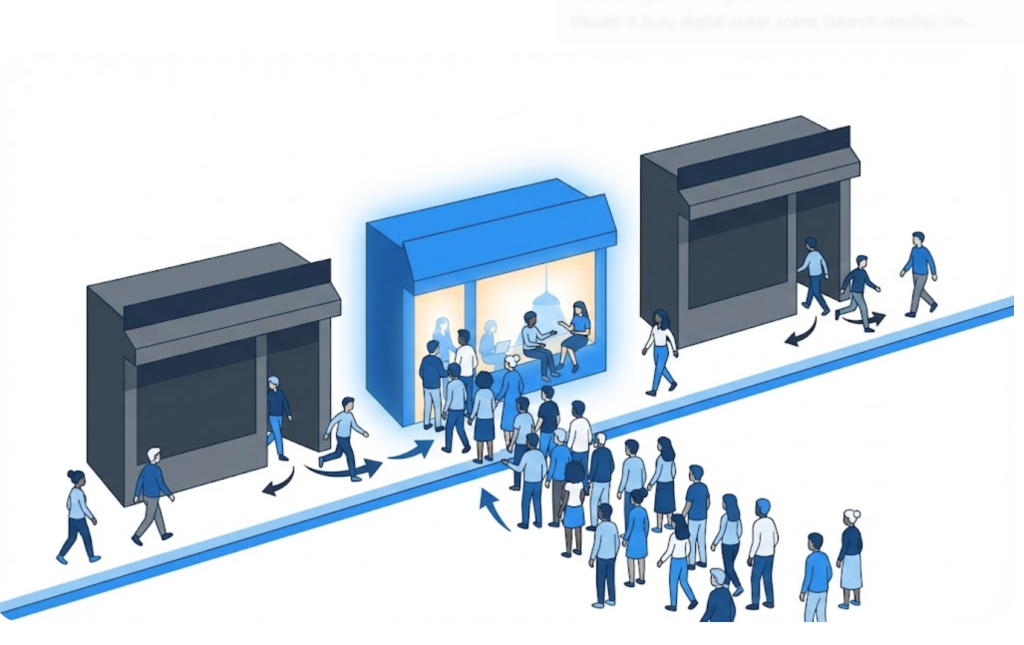
To understand Navboost, stop thinking of Google as a librarian and start thinking of it as a talent show judge.
- Crawling & Indexing is the audition. You get on stage.
- Backlinks are the judges’ initial scores. They get you into the finals.
- Navboost is the audience vote. This decides who wins.
Navboost looks at 13 months of user click logs. It analyses millions of searches to see which results people actually prefer for any given query. It segments this data by device (Mobile vs. Desktop) and by location (London vs. Leeds). It looks for three specific signals:
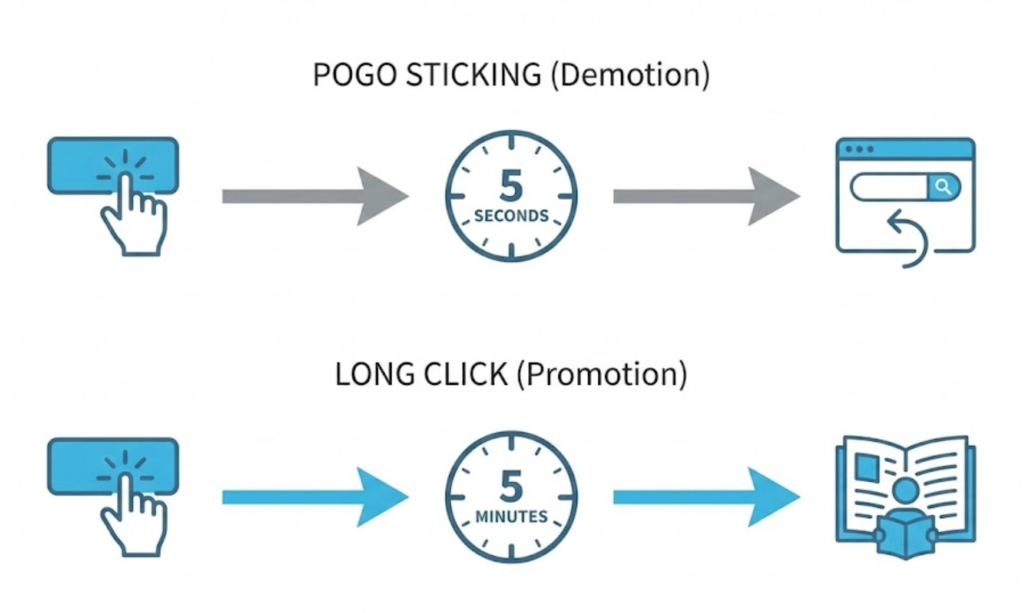
1. Good Clicks (The “Long Click”)
A user searches for “Best Hiking Boots.” They click your link. They stay on your site for 5 minutes, read the guide, scroll to the bottom, and maybe click a product. They do not return to Google to search again.
This is a Good Click (or “Long Click”). It tells Navboost: “The user found exactly what they wanted here. This result is highly relevant. Rank it higher.”
2. Bad Clicks (Pogo-Sticking)
A user clicks your link. 5 seconds later, they hit the “Back” button and click on your competitor’s link instead.
This is Pogo-Sticking. It is the single most damaging signal in SEO. It tells Navboost: “This result was bad. It didn’t answer the question. It was spammy, slow, or ugly.” If this happens enough, Google will demote you, no matter how many backlinks you have.
3. The “Last Longest Click”
This is the ultimate prize. Google wants your site to be the last place the user visits for that session. It means their journey is over; their problem is solved. Being the “Last Click” is the strongest ranking signal possible.
Navboost vs. RankBrain (The Difference)
People often confuse these two AI systems, but they do very different things.
- RankBrain is an AI that tries to understand new, never-before-seen queries. It guesses what the user means based on semantics and synonyms.
- Navboost is a system that memorizes past user behavior for known queries. It doesn’t guess; it remembers. It knows that for the query “Facebook,” 99% of people click the first link, so it locks that link in place.
Navboost is about pattern recognition. It crowdsources quality control to the users themselves.
The “Chrome” Factor & Clickstream Data
Here is the scary part. The 2024 leaks suggested that Google doesn’t just watch what you do on the search results page. It likely uses data from the Chrome Browser (which has billions of users) to track user behavior even after they leave Google.
This is known as “Clickstream Data.” It means Google potentially knows:
- How many pages users visit on your site.
- How long they spend reading.
- If they actually convert (fill out a form or buy).
This confirms that User Experience (UX) is a direct SEO ranking factor. If your site is annoying, broken, or confusing, Navboost will punish you.
How to Optimise for Navboost (User-Centric SEO)
You can’t “hack” Navboost. You can only satisfy it. To win, you need to optimize for the user, not the bot. This is central to our SEO services.
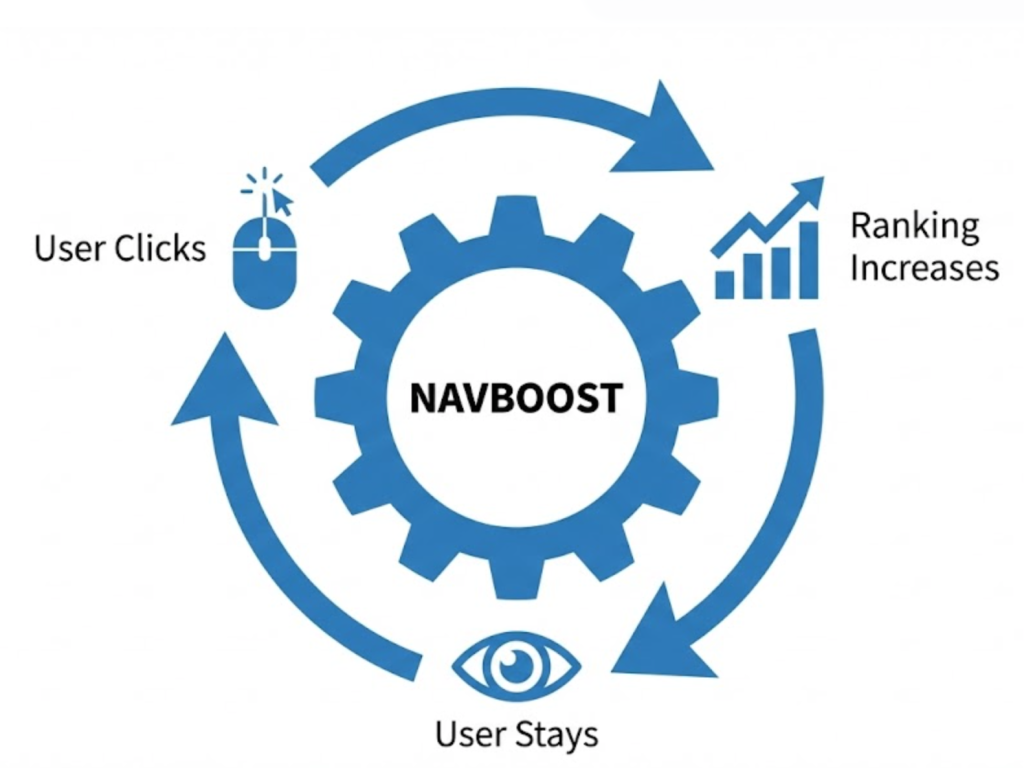
1. Win the Click (CTR)
Navboost can’t measure your site if nobody clicks on it. You need to win the Click-Through Rate (CTR) battle.
- Write compelling Title Tags that promise a specific benefit.
- Write emotional Meta Descriptions that act as ad copy.
- Use Schema Markup (Stars, FAQs) to occupy more visual space.
2. Win the Stay (Dwell Time)
Once they click, you must keep them there. This reduces Pogo-Sticking.
- Match Search Intent: If they want a guide, give them a guide. If they want a product, give them a product. Don’t trick them.
- Improve Page Speed: If your site takes 5 seconds to load, they will bounce before Navboost even registers a “Good Click.” (See our Core Web Vitals guide).
- Visual Hooks: Use a high-quality Hero Section to confirm they are in the right place immediately.
3. Localisation (Geographic Slicing)
Navboost is location-aware. It knows that users in Leeds click on different results than users in London for the query “best pizza.”
If you are a local business, ensure your Local SEO is perfect. Create location-specific pages so Navboost learns to associate your brand with your specific city, boosting your rankings for users in that area.
The Takeaway
Navboost proves that SEO and UX are the same thing.
You cannot rank a bad website anymore. You cannot rank “thin” content. You cannot rank a site that frustrates people. The crowd will vote you down, and Navboost will listen.
At Saint Digital, we design for Navboost by designing for humans. We build fast, beautiful, helpful websites that earn the “Long Click.” We turn your traffic into a positive ranking signal.
Is your user experience dragging down your SEO? Let’s fix it.
Design for humans. Rank for robots.
If users hate your website, Google will too. We at Saint Digital are UX-Led SEO experts. We improve your design, speed, and content to ensure users stay longer, engage deeper, and send the right signals to Navboost.
Let’s improve your experience.
Learn more from our Glossary
© Saint Digital Ltd, 2020-26, all rights reserved.