
NAP Consistency

What is NAP Consistency? (The Foundation of Local Trust)
NAP is an acronym that stands for Name, Address, and Phone Number.
In the world of Search Engine Optimisation (SEO), NAP Consistency refers to the critical practice of ensuring that these three pieces of business information are identical down to the last character across every single platform on the web. This includes your own website, your Google Business Profile, social media channels like Facebook and LinkedIn, and third-party business directories like Yell, Yelp, and Tripadvisor.
It sounds simple. You might think, “Who cares if I write ‘Street’ or ‘St.’?”
Google cares. A lot. NAP consistency is one of the most fundamental ranking factors for Local SEO. If you get this wrong, you are essentially invisible to anyone searching for services “near me.”
Is your business invisible locally?
Inconsistent data confuses Google and kills your local rankings. Learn the complete framework for auditing your citations and dominating the Map Pack in our comprehensive guide.
Why does NAP Consistency matter?
Think of NAP consistency as a “Confidence Score” for search engines.
Google’s primary goal is to provide users with accurate information. It is terrified of sending a user to a business that is closed, has moved location, or has a dead phone number. To prevent this, its algorithm scans the web looking for mentions of your business (known as citations) to cross-reference your details.
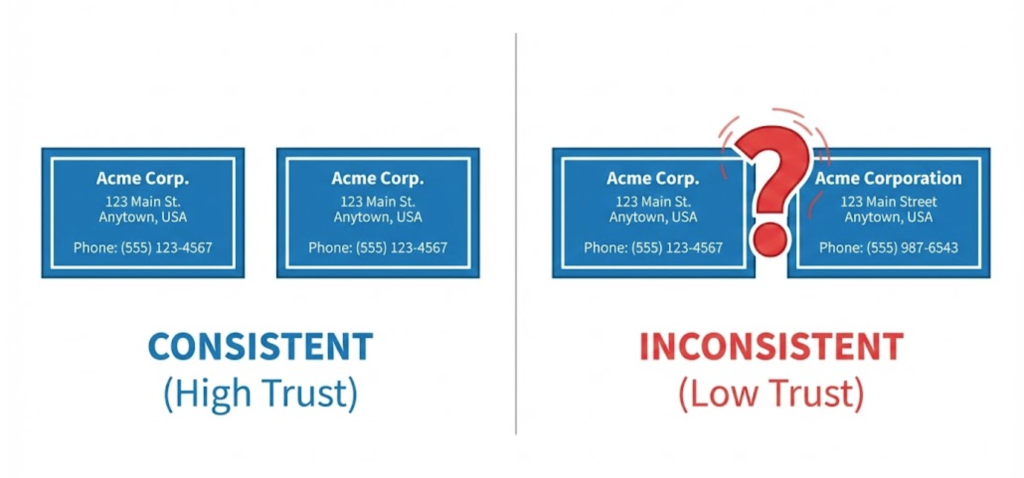
- High Confidence (Rank Higher): If your Name, Address, and Phone number match perfectly everywhere (from your Facebook page to your local Chamber of Commerce listing), Google trusts that your business is legitimate and operational. This boosts your chances of ranking in the “Local 3-Pack” (the map results).
- Low Confidence (Rank Lower): If your data conflicts (e.g., your website lists a new 0113 number but Yell lists an old 07 mobile number), Google gets confused. When the algorithm is unsure which data is correct, it often chooses not to show your business at all to avoid a bad user experience.
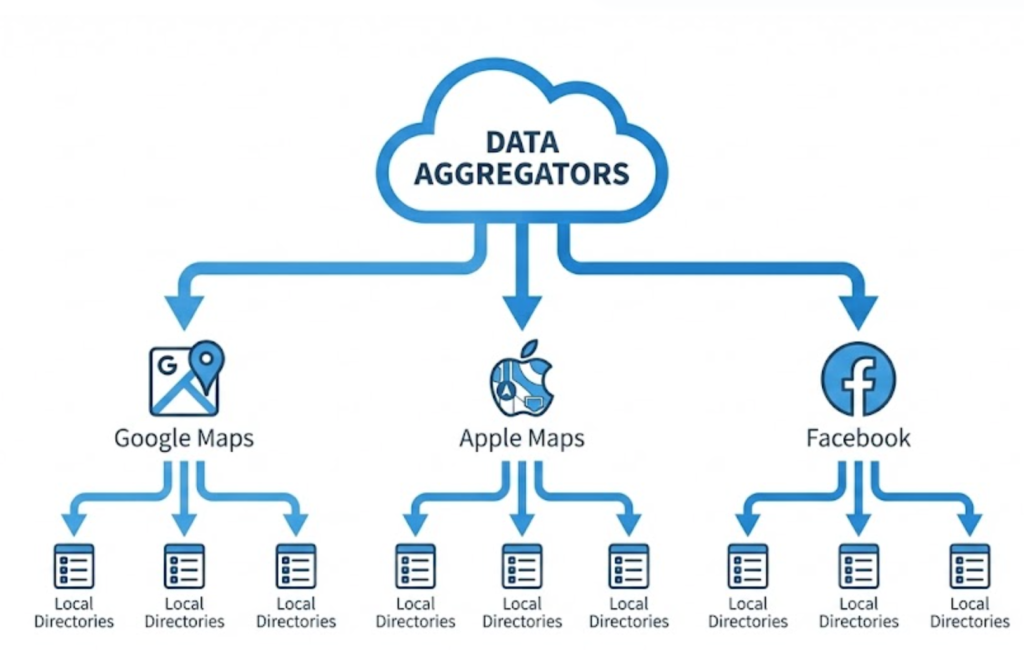
As can be seen in the above flowchart, ultimately, the data flows down from its source.
The Two Types of Citations
When Google scans the web for your NAP data, it looks at two types of sources.
1. Structured Citations
These are formal business listings on directory sites. The data is presented in a specific format.
- Google Business Profile
- Bing Places
- Yell.com / Yelp / TripAdvisor
- Facebook Business Page
2. Unstructured Citations
These are casual mentions of your business in text on other websites. They are harder to control but very valuable.
- A local news article mentioning your shop opening.
- A blog post reviewing your service.
- An event listing where you are a sponsor.
Google reads all of these. If a local newspaper article lists your old address from 2019, it creates a “data conflict” that can hurt your rankings today.
Common NAP Issues (The “Silent Killers”)
Even small discrepancies that look fine to a human can confuse a bot. Common issues that hurt rankings include:
- Formatting Variations: Writing “10 Station Street” on one site and “10 Station St.” on another. While Google is getting smarter at understanding abbreviations, consistency is still the safest bet.
- Suite/Unit Numbers: Including “Unit 4” on your website but omitting it on your Google Profile. This creates a location mismatch.
- Legacy Data: Forgetting to update a phone number on an old directory listing created five years ago.
- Trading Names: Listing yourself as “Saint Digital Ltd” on Companies House but just “Saint Digital” on Facebook. Pick one format and stick to it everywhere.
The “Source of Truth”: Schema Markup
It’s not just about what is visible to humans. You must also ensure your NAP data is hard-coded for robots.
We use LocalBusiness Schema (JSON-LD) to explicitly tell Google the “official” version of your NAP. This code sits in the header of your website and looks like this:
"name": "Saint Digital",
"address": {
    "streetAddress": "123 Example Street",
    "addressLocality": "Leeds",
    "postalCode": "LS1 1AA"
},
"telephone": "+441131234567"
This acts as the master record. Even if a third-party directory has it wrong, this code tells Google: “Ignore them. THIS is the correct data.”
The Data Ecosystem: Aggregators
You might wonder: “How did my business get listed on 50 directories I’ve never heard of?”
This happens because of Data Aggregators (like Foursquare or Neustar). These massive databases scrape business info and sell it to smaller directories. If your data is wrong in an Aggregator, it will trickle down and “infect” hundreds of smaller sites across the web.
Fixing your NAP isn’t just about updating your Facebook page; it’s about cleaning the data at the source (the Aggregators) so the correct info flows downstream.
How We Fix NAP Issues (The Saint Digital Process)
Fixing NAP inconsistency requires a manual audit of your digital footprint.
At Saint Digital, our SEO services include using specialist tools to scan hundreds of directories to identify incorrect data. We then manually update these citations to ensure your digital record is 100% spotless, building the solid foundation required for local rankings.
Ready to get started on attaining NAP consistency?
Confused by citations?
Inconsistent data could be silently killing your local rankings. If you’re struggling to appear in the Map Pack, let us audit your digital footprint.
Use the form to the right to contact Saint Digital. We’ll be back in touch within 24 hours.
Confused by citations?
Inconsistent data could be silently killing your local rankings. If you’re struggling to appear in the Map Pack, let us audit your digital footprint.
Use the form to the right to contact Saint Digital. We’ll be back in touch within 24 hours.
Learn more from our Glossary
© Saint Digital Ltd, 2020-26, all rights reserved.