
Quality Rater Guidelines

What are the Quality Rater Guidelines? (Google’s Secret Rulebook)
Most people think Google Search is entirely automated—a black box where algorithms decide your fate based on math. They are only half right.
Behind the algorithm, there is a human workforce. Google employs over 16,000 “Search Quality Raters” around the world. Their job is to manually review websites and grade them.
But they don’t just guess what is “good.” They follow a strict, 170+ page manual known as the Quality Rater Guidelines (QRGs).
Welcome to the decoder ring. The Quality Rater Guidelines are the “Answer Key” to SEO. They tell us exactly what Google wants the algorithm to value, from trustworthiness to user experience.
At Saint Digital, we don’t just guess what Google likes. We study the QRGs to ensure our clients’ content meets the rigorous standards set by human reviewers.
Is your content failing the “Human Test”?
Algorithm updates often target sites that fail on Trust and Expertise. Learn how to future-proof your site by building true authority in our comprehensive guide.
The Myth: Do Raters Control Your Rankings?
This is the most common misconception in SEO.
Quality Raters cannot ban your website. They do not have a button that says “Rank this lower.”
Instead, they act as a feedback loop for Google’s engineers.
The Process:
- Google Engineers tweak the algorithm (e.g., “Let’s value speed more”).
- They run a test search and show the results to the Quality Raters.
- The Raters use the Guidelines to grade the results. “Result A is helpful. Result B is spam.”
- If the algorithm produced high-quality results according to the Raters, the update is released.
In short: Raters don’t grade you; they grade the algorithm. But if your site matches what Raters are told to look for, the algorithm is trained to rank you higher.
The Core Metric: Page Quality (PQ)
The Guidelines ask raters to assign a “Page Quality” score. To get a “High” score, you need three things:
1. E-E-A-T (The Holy Grail)
We cover this in our dedicated E-E-A-T article, but the Guidelines state clearly that this is the most important factor for quality.
- Experience: Does the author have first-hand experience? (e.g., A review of a car by someone who drove it).
- Expertise: Is the author qualified? (e.g., Medical advice from a doctor).
- Authoritativeness: Is the website a known leader in this niche?
- Trust: Is the site secure, transparent, and honest?
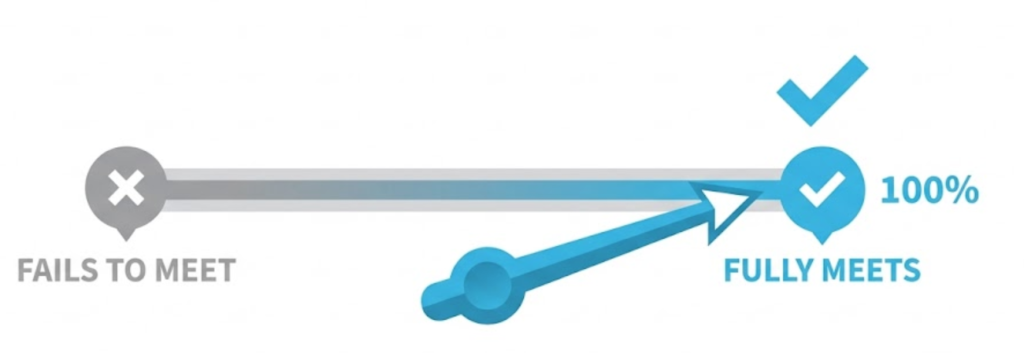
2. The “Needs Met” Rating
Raters also grade how well a result satisfies the user. This is a scale from “Fails to Meet” to “Fully Meets.”
To score “Fully Meets,” your content must be comprehensive. If a user searches for “How to tie a tie,” a page that gives a history of neckties gets a low score. A page with a clear video and step-by-step diagrams gets a high score. It isn’t just about length; it’s about utility.
3. Main Content (MC) Quality
The Guidelines distinguish between:
- Main Content (MC): The article, video, or tool itself.
- Supplementary Content (SC): Sidebar links, navigation.
- Ads/Monetization: Popups and banners.
If your Ads distract from or cover the Main Content, Raters are instructed to mark the page as “Low Quality.”
The Danger Zone: YMYL (Your Money or Your Life)
The Guidelines have a specific section for “Your Money or Your Life” topics. These are pages that could impact a person’s future happiness, health, financial stability, or safety.
- Examples: Medical advice, legal advice, news, banking pages.
For YMYL pages, the standard for E-E-A-T is extremely high. A random blog can write about “Best Cat Movies” (Non-YMYL). But if a random blog writes about “How to Cure Diabetes,” Raters are told to rate it “Lowest Quality” unless the author is a verifiable medical expert.

What Flags a Page as “Lowest Quality”?
According to the manual, these are immediate failures:
- Lack of Purpose: Pages that seem to exist only to show ads, with no value to the user.
- Deception: Sites that impersonate other brands or hide their true ownership.
- Hate Speech: Content that promotes violence or discrimination.
- Scraped Content: Copy-pasting content from Wikipedia or other sources without adding value.
The Takeaway
You cannot read the algorithm’s code, but you can read its instructions.
The Quality Rater Guidelines are the blueprint for what Google wants to build. If you align your content with these principles—prioritizing expertise, trust, and user satisfaction—you are “future-proofing” your site against algorithm updates.
At Saint Digital, we build strategies based on these human standards, not just keyword density.
Does your site pass the human test? Let’s audit it.
Does your content meet the Gold Standards?
Google’s human raters have a 170-page manual on how to spot low-quality websites. Do you know if your site passes their test?
At Saint Digital, we audit websites against the official Quality Rater Guidelines to find the trust signals you are missing.
Learn more from our Glossary
© Saint Digital Ltd, 2020-26, all rights reserved.