
Domain Authority
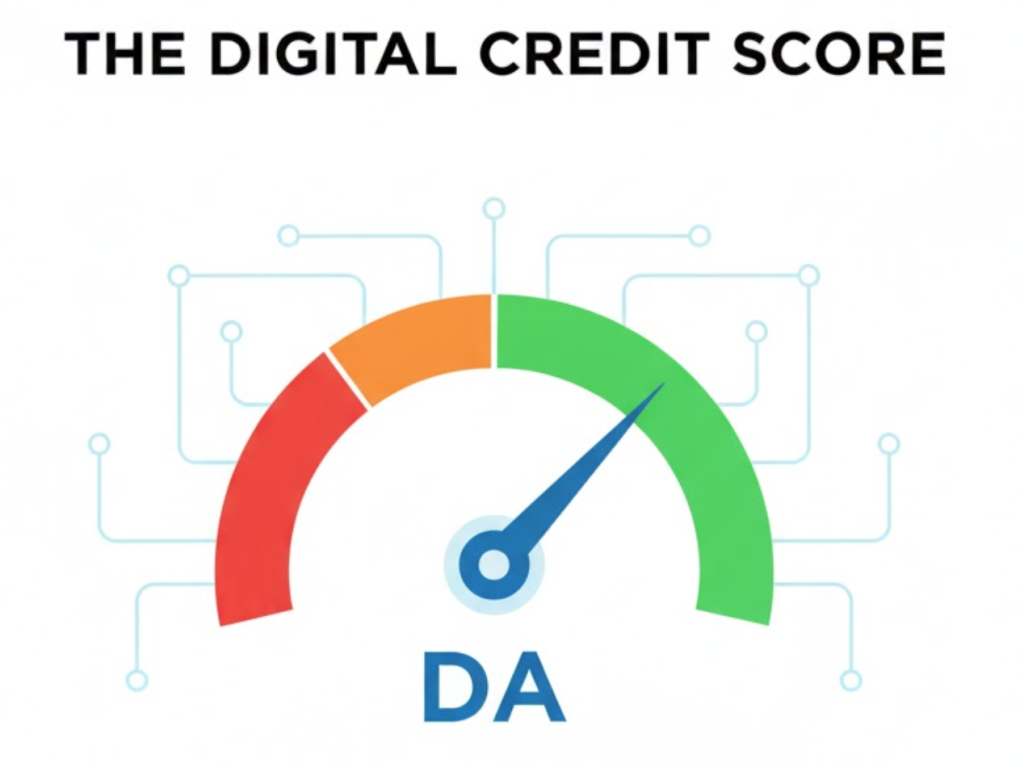
What is Domain Authority? (The “Credit Score” of Your Website)
You’ve seen it in an SEO report. It’s a single number, usually from 1 to 100: Your “Domain Authority” or “DA.”
And then you see your competitor’s DA is 10 points higher. Panic sets in. You must be losing, right?
Hold on. Let’s put that number in its place.
Welcome to the decoder ring. Domain Authority is one of the most useful, and by far one of the most misunderstood metrics in SEO. At Saint Digital, we help clients understand what this number really means.
Struggling to grow your Authority?
You can’t fake authority. You have to earn it. Our Beginner’s Guide explains how to earn the high-quality links that actually move the needle (and your DA score).
Domain Authority is NOT a Google Metric
Let’s say that again: Domain Authority is not, and has never been, a metric used by Google.
Google’s algorithm doesn’t know what your “DA” is. Domain Authority is a “proprietary” score created by the SEO software company Moz.
Think of it like a Credit Score for your website. A bank (Google) does its own checks before giving you a loan (Ranking), but your Credit Score (DA) is a useful “best guess” indicator of your trustworthiness.
How is Domain Authority Calculated?
It’s all about Backlinks. DA is calculated by looking at two main things:
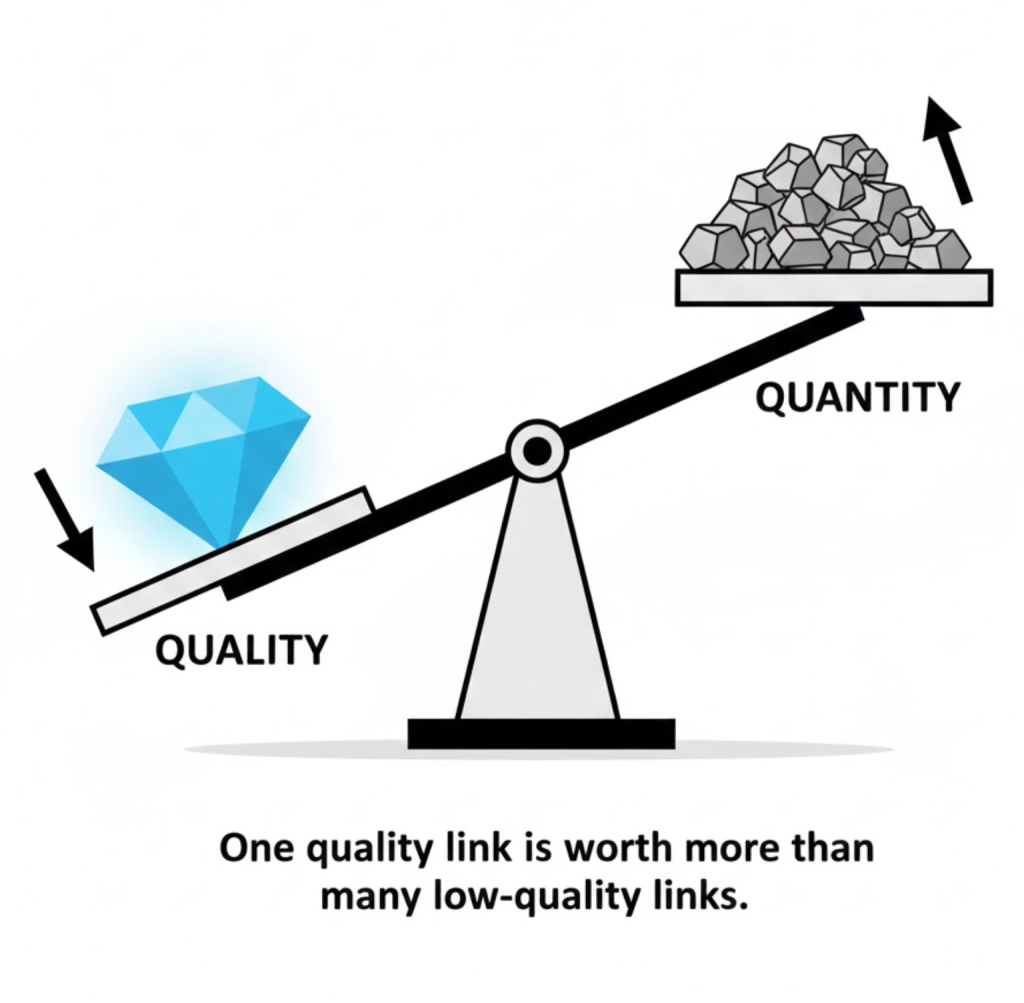
- Quantity: How many different websites are linking to you?
- Quality: Are those links coming from tiny blogs, or huge sites like the BBC?
A single link from a high-authority site (like a university) will raise your DA score way more than 1,000 links from spammy directories.
Technical Insight: The Logarithmic Scale
This is the part most people miss. DA is Logarithmic, not linear.
This means it is relatively easy to grow your score from DA 10 to DA 20. But it is significantly harder to grow from DA 70 to DA 80. As your score gets higher, the “difficulty” ramps up. This is why you shouldn’t panic if your score plateaus; moving the needle at the top requires massive effort.
The Confusion: DA vs. DR vs. AS
Different SEO tools use different names for this concept.
- Moz: Uses Domain Authority (DA).
- Ahrefs: Uses Domain Rating (DR).
- Semrush: Uses Authority Score (AS).
Pro Tip: Never compare your DA to your DR. Pick one tool and stick to it.
What is a “Good” Domain Authority Score?
The answer is always: “Better than your competitor’s.”
DA is relative. If you’re a local plumber and your competitors have a DA of 10, then a DA of 15 is fantastic. If you’re a national brand competing with Amazon (DA 95), a DA of 60 is still an underdog.
The Big Flaw: Why “Low DA” Sites Can Win
Have you ever seen a new, low-DA site outrank a big, high-DA brand? It happens constantly.
Why? Because Google ranks Pages, not Websites.
A specific page on a low-authority site can outrank a page on a high-authority site if the content is more relevant, helpful, and better optimized for Search Intent.
The Takeaway
Is Domain Authority useless? Not at all. It’s a great compass to track your progress.
But never sacrifice content quality just to “game” your DA score. Your site’s real authority is built on trust.
At Saint Digital, our SEO services focus on building genuine authority through PR and high-quality content, not vanity metrics.
Ready to build a reputation that lasts?
Stop Chasing Scores. Start Building Real Authority.
Your DA is just a number. Your site’s real authority is built on high-quality content, a flawless user experience, and earned trust. We at Saint Digital focus on what actually ranks you.
Ready to build a site that Google and users trust for the long haul? Let’s talk.
Learn more from our Glossary
© Saint Digital Ltd, 2020-26, all rights reserved.